
China logistics service for brands and importers: coordinate factory collection, consolidation and shipping around a clearly agreed handover. Compare the complete shipment scope, not just the lowest freight rate. Start with your pickup locations, packed cargo details, destination and cargo-ready date.
HunterSourcing is a China sourcing agent. We coordinate agreed shipment requirements and communication with the appointed logistics providers. Your quotation identifies the services, charges and responsible parties for your project, including which provider handles transport, warehousing or customs work.
Quick answer: a comparable logistics quotation names the pickup and delivery points, transport mode, Incoterm, packed cargo data, chargeable quantity, included charges and exclusions. Confirm the scope and authorise any chargeable work before it starts.
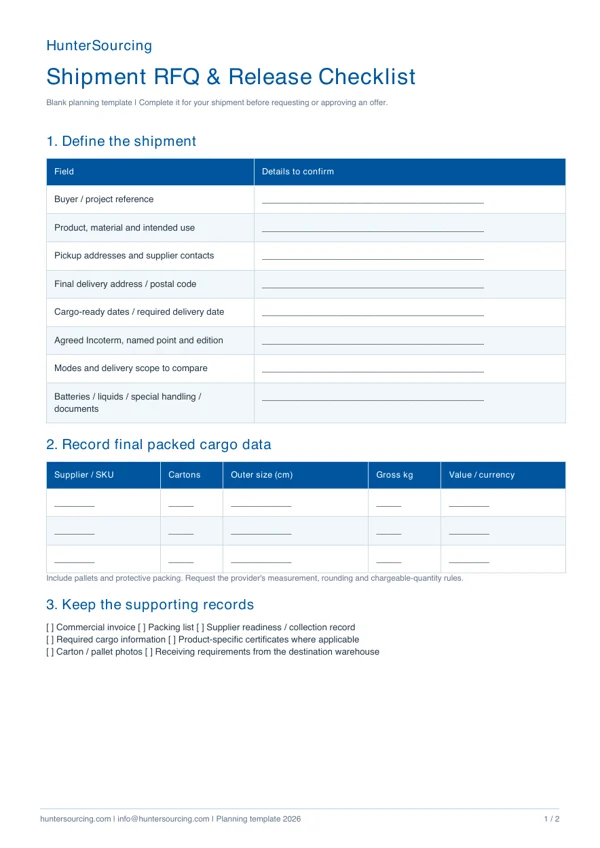
Prepared by the HunterSourcing team. Latest update: 2026. Download the Shipment RFQ & Release Checklist (PDF).
1. Choose the Freight and Delivery Scope
Choose a route around your cargo and receiving requirements. Express, air freight, sea freight and rail are different services, with different acceptance rules, billing measures and handovers. Availability and delivery estimates need a shipment-specific check.
| Option | Useful comparison | Confirm before booking |
|---|---|---|
| Express courier | A parcel-based route for suitable samples or smaller consignments | Accepted cargo, chargeable weight, clearance scope, surcharges and final address |
| Air freight | Airport handling plus the agreed origin and destination services | Airports, chargeable weight, minimums, security/handling and final-delivery scope |
| Sea freight: LCL | Less-than-container-load cargo sharing a container | Origin and destination handling, volume/weight basis, minimums and receiving fees |
| Sea freight: FCL | A full-container-load booking | Container type, stuffing plan, local charges, weight limits and free-time terms |
| Rail or multimodal | An alternative on an available lane where the cargo is accepted | Current route, border handovers, restrictions, terminal services and last mile |
Ask each provider to quote the same endpoints: factory-to-port, port-to-port or factory-to-final-address, as applicable. Consolidating several suppliers does not automatically mean LCL; the combined cargo may move by air, in an LCL shipment or in a dedicated container.
For Amazon-specific labels, preparation and receiving instructions, use our separate Amazon FBA sourcing and shipping page. This page focuses on general shipment coordination and quote comparison.
2. Compare an Itemised Logistics Quote
An attractive main-freight price can leave origin or destination charges outside the offer. Send the same cargo sheet to each provider and request the complete scope in writing. The table below is a comparison checklist, not a current freight tariff.
| Quote line | What to ask for | Cost or timing exposure |
|---|---|---|
| Factory collection | Pickup addresses, cargo readiness, loading and payer | Separate collections, waiting, remote locations or a missed appointment |
| Receiving and consolidation | Carton count, condition record, storage allowance and service units | Storage beyond allowance, receiving fees or additional handling |
| Repacking and pallets | Materials, dimensions, labour and approval point | Changed packed volume or additional protective packing |
| Origin and export | Documentation, origin terminal/warehouse charges and export services | Missing documents, inspections or charges outside the quoted scope |
| Main transport | Mode, lane, chargeable quantity, unit rate and minimum | Weight/volume remeasurement, rate expiry or capacity change |
| Destination and customs | Terminal/warehouse, broker, duties and taxes: included or excluded | A freight-only offer that leaves destination costs payable locally |
| Final delivery | Address, appointment, unloading and receiving reference | Redelivery, waiting, special equipment or an incompatible warehouse booking |
| Insurance and payment | Policy scope, deductible, currency, payer and payment milestones | Coverage gaps, exchange/transfer costs or changes not approved in advance |
Record the quote date, validity, currency, minimum charge, rate unit, exclusions and change-approval process. Maersk’s rate guidance separates freight from origin and destination charges; use the same itemised approach when assessing your own offers.
HunterSourcing’s coordination fee and any third-party charges are confirmed for the agreed project. There is no single product MOQ or universal shipping price for a logistics service: ask for service minimums and the total payable amount for your actual consignment. Confirm when each payment is due and verify beneficiary details through an established contact before transferring funds.
3. Check Packed Volume and Chargeable Weight
Measure the final outer packing, including pallets or protective materials. Product dimensions alone do not describe the shipment that the provider will handle. Ask for the measurement record and the billing rule used in the offer.
| Published reference | Calculation or rule | Scope to confirm |
|---|---|---|
| DHL Express guide | Length × width × height in cm ÷ 5,000 = volumetric kg; compare with actual kg | Example from the linked DHL Express guide. Confirm the booked service’s divisor, rounding and per-package rules |
| DHL Global Forwarding guide: air | The guide uses a 6,000 cm³/kg conversion | An air-freight example, not a universal divisor for every carrier or contract |
| DHL Global Forwarding guide: LCL | The guide illustrates a 1:1 density ratio: 1 m³ corresponds to 1,000 kg | Check the applicable weight/measure rate, shipment minimum and origin/destination handling basis |
Primary references: DHL Express weight and dimensions and DHL Global Forwarding chargeable-weight guide. These examples explain the arithmetic; your provider’s applicable service terms control the booking.
Worked example — illustrative figures, not a quotation: one packed carton measures 60 × 40 × 40 cm and weighs 12 kg. Its volume is 96,000 cm³, or 0.096 m³. Dividing by 5,000 gives 19.2 volumetric kg; dividing by 6,000 gives 16 volumetric kg. Both exceed the assumed 12 kg actual weight. Ten identical cartons total 0.96 m³ and 120 kg actual weight, before additional packing. Their calculated volumetric totals would be 192 kg or 160 kg under those respective rules, before rounding and minimums.
A lower calculated chargeable weight does not necessarily mean a lower total price: the unit rate, minimums, handling and delivery scope can differ. Confirm the final packed measurements and revised payable total before releasing the booking.
4. Consolidate Suppliers with a Clear Release Plan
Combining orders can simplify the shipment, but it also adds custody changes. Agree whether suppliers deliver to a nominated receiving point or an appointed provider collects. Confirm the receiving address, booking reference, contact and charges before sending any cartons.
- 1. DefineConfirm cargo, pickup points, destination, scope and required documents.
- 2. ReceiveRecord supplier-level carton counts, labels, visible condition and discrepancies.
- 3. PrepareAgree any inspection, repacking, palletising and final cargo measurements.
- 4. ApproveCompare the updated quote, close exceptions and obtain the buyer’s release.
- 5. Hand overIdentify the appointed provider and retain the collection or transport reference.
- 6. ReconcileCheck delivery evidence against the destination receiving record and close discrepancies.
| Evidence to request | Decision it supports | What to reconcile |
|---|---|---|
| Supplier-level receiving log and carton photos | Whether expected cartons arrived in the recorded condition | Supplier packing list, carton/SKU labels and any shortages or damage |
| Final packed dimensions and weight | Whether the freight basis matches the prepared cargo | Repacking changes, pallet dimensions and the revised quote |
| Inspection and release record | Which goods the buyer authorises to move | Affected quantities, open defects and any split-shipment decision |
| Collection / transport and delivery references | Who holds the goods at each stage | Provider handover, destination receiving count and proof of delivery |
If one supplier is late, compare holding all cargo with splitting the shipment. Obtain revised storage, handling, freight and delivery estimates for both options; the buyer approves the change. For a quality issue, record the affected goods and agreed correction before release. See China quality inspection for the product-check workflow.
5. Agree Documents, Customs and Handover Responsibilities
Assign a named contact to each handover. A sourcing coordinator, warehouse, freight forwarder, carrier, customs broker, importer and insurer perform different roles. Confirm the contracted parties, their applicable credentials and who is authorised to give release instructions.
| Role / document | Confirm in the shipment record | Acceptance point |
|---|---|---|
| Supplier / exporter | Commercial invoice, packing list, product description, quantity, value and relevant certificates | Information matches the goods and the responsible parties approve any correction |
| Warehouse / collection provider | Receipt, counts, condition, storage terms and final packing data | Discrepancies and extra work are recorded before handover |
| Forwarder / carrier | Booking reference, accepted cargo, cut-offs, transport document and delivery scope | The booked service and cargo details match the approved quotation |
| Importer / appointed broker | Importer and consignee details, declaration inputs, required permits and tax/payment arrangements | Destination-specific requirements confirmed by the responsible parties before dispatch |
| Buyer / receiving warehouse | Release instruction, delivery appointment, labels and receiving reference | Proof of delivery reconciled with the receiving count |
| HunterSourcing coordinator | Agreed coordination scope, provider contacts, open points and buyer decisions | Keep the approved quote and handover versions together |
The required document set depends on the product, route and destination. Maersk’s shipping-document overview explains common documents, including the commercial invoice, packing list and transport document. Product-specific certificates and permits need their own check; one general company certificate is not approval for every shipment.
Write the Incoterm with the named place or port and the edition. ICC’s Incoterms 2020 guidance distinguishes 11 rules: 7 for any mode and 4 for sea/inland-waterway transport. The rules allocate specified responsibilities, costs and risks; payment and ownership terms still need agreement. A DDP label alone is not evidence of correct customs declarations: identify the importer, broker and records available for your shipment.
For a packed container subject to the SOLAS requirement, IMO’s verified gross mass guidance describes two methods: weighing the packed container, or an approved calculation using cargo, packing materials and container tare. Confirm the applicable procedure and responsible party with the provider. This is a container-loading requirement, not a generic parcel calculation.
Declare batteries, liquids, powders, magnets or other special cargo before booking. Ask the provider to confirm classification, documents, packing and acceptance for the actual product and route. Dangerous-goods acceptance depends on the appointed operator and applicable rules; do not book on a general assurance that every cargo type is accepted.
6. Plan Transit, Insurance and Exceptions
Ask for milestones rather than a single unexplained transit-day promise: cargo ready, collection, receiving, documentation close, carrier cut-off, planned departure, destination clearance and delivery appointment. Distinguish an estimate from a booked commitment and record who updates you when a milestone changes.
| Illustrative buying scenario | What to compare | Next evidence / approval |
|---|---|---|
| Small shipment needed for a launch | Express and air options on the same packed-cargo and final-address basis | Cargo acceptance, chargeable weight, total cost and realistic receiving date |
| Several suppliers ready on different dates | Hold versus split, with receiving/storage/repacking charges | Supplier readiness register, revised dimensions, quote and buyer instruction |
| Bulky cargo going to an overseas 3PL | LCL versus FCL where applicable, plus destination and receiving conditions | Unloading/appointment requirements, customs roles and complete delivery scope |
These scenarios are planning examples, not reports of completed HunterSourcing customer orders. For an actual project, request category-relevant evidence that may be shared, a named coordinator, provider details and sample document formats. If you are still selecting the product or factory, start with product sourcing in China.
Check cargo insurance separately from a logistics provider’s contractual liability. Ask for the insured party, covered stages, exclusions, deductible, claim evidence and notice deadlines. Maersk’s cargo-insurance information provides a provider-specific example; your policy and contract determine the actual cover. Keep receiving photos, packing records, invoices and handover documents.
If cargo is damaged, short or delayed, preserve the evidence, identify the responsible contact and request a written next step. Agree who reports the issue, who approves correction or onward delivery, and what remains unresolved. Close the coordination record after the receiving outcome and any agreed follow-up are documented; compensation follows the applicable contract and policy.
7. China Logistics Service FAQ
7.1 How do I choose a China logistics service when I am a small importer?
Shortlist providers against a real shipment brief: supplier locations, cargo type, packed dimensions, destination and delivery deadline. Ask who will collect the goods in China, which destination partner will handle delivery, and who will resolve exceptions. Request the contracting entity, written scope, relevant trade-lane references, itemized charges and subcontractor arrangements. Compare how clearly each provider answers these questions before appointing one. A trial shipment can help assess communication and invoice accuracy. Minimum charges, service availability and lead times are project-specific.
7.2 Why do China shipping quotes differ, and how can I compare the total cost?
Compare quotes only after matching the shipment details and service scope. Give each provider the same factory pickup address, final delivery address, product description, cargo value, packed measurements and requested delivery timing. Ask for pickup, origin handling, export documentation, main freight, destination handling, customs brokerage and final delivery to be shown separately, with taxes identified as included or excluded. Also request storage, inspection-related charges, redelivery exclusions and quote validity. A lower headline price does not establish a lower complete cost. Every total remains project-specific until the provider confirms the assumptions in writing.
7.3 Under an EXW order, should the factory deliver to the warehouse or should my forwarder collect?
Agree the physical handover before the goods are ready. Ask the factory and logistics provider to confirm the collection address, warehouse receiving details, booking reference, packaging condition, loading arrangements and who pays each domestic transport charge. Identify who will prepare export documents and who will handle shortages or damage found at receipt. For small cartons, request a factory-arranged domestic delivery option as well as a forwarder-arranged pickup option. Choose using the actual locations and handling needs; do not assume a trade-term label alone settles every collection detail.
7.4 Should I consolidate Chinese supplier orders with a warehouse or with my freight forwarder?
Compare the full workflow and accountability of both arrangements. Request a receiving report by supplier, carton counts, damage photographs, measured packing data, storage terms and a clear release process. If an independent warehouse is used, confirm that your nominated forwarder can collect there and that both parties agree on the handover record. If the forwarder also consolidates, ask how it records shortages and approves repacking. Compare receiving, storage, handling, palletizing and documentation charges together. Consolidation is a project-specific option, not an automatic saving on every shipment.
7.5 What happens if one factory is late when several suppliers share a shipment?
Set a consolidation cutoff and an exception plan before supplier deliveries begin. Ask the coordinator to report each order as ready, collected, received, checked or awaiting documents. If a supplier misses the cutoff, compare holding the complete shipment with releasing the ready cargo and sending the balance separately. Request the extra storage, handling and freight consequences before approving the change. Give urgent products an explicit priority so they are not held automatically for less urgent items. Ready dates, departure opportunities and storage allowances must be confirmed for the project.
7.6 How should I compare express, air freight, LCL and FCL for goods sourced in China?
Ask for options using the final packed cargo data and the same delivery endpoint. Record gross weight, external carton or pallet dimensions, product type and any special handling needs. Request each option's billing basis, minimum charges, origin and destination handling, delivery arrangements and estimated milestones. Do not select a mode from product weight alone or compare a port-only quote with a door-delivery quote. Ask whether repacking changes freight charges without weakening protection. The suitable mode, cost and timing are project-specific; there is no universal weight or volume cutoff for every route.
7.7 If a shipment is quoted DDP, what customs and handover details should I confirm?
Ask for the agreed delivery place, the parties responsible for export and import procedures, the named importer of record, and the customs broker's contact details. Confirm which duties, taxes and delivery charges are included, what supporting documents you will receive, and how requests for product details or inspection will be handled. Check that the written order and logistics agreement describe the same arrangement. Have a qualified destination broker review unclear declarations or responsibilities. Do not treat an all-inclusive label as proof that the paperwork or product requirements have been checked.
7.8 What shipment evidence should I request if tracking works only on the logistics provider's website?
Ask the provider to explain each shipment stage and which reference identifies it: warehouse receipt, freight booking, transport document where applicable, destination handling and final-mile delivery. Request dated status evidence, the current responsible party and the agreed delivery address. A private tracking reference by itself does not prove either fraud or completed carrier handover. If progress or extra charges cannot be explained, keep the order, payment records, messages and shipment documents together and escalate through the contracted provider or purchasing platform. Confirm any applicable dispute deadline from that platform's current terms.
7.9 What should I check about cargo insurance and responsibility for subcontracted pickups?
Request the proposed policy wording and claims procedure before dispatch. Ask whether the cover applies to factory pickup, consolidation storage, repacking, international transport and final delivery for your specific cargo. Identify the insured party, deductibles, exclusions, evidence requirements and notification deadlines. Separately ask the contracting logistics provider how it handles a loss involving a subcontractor; do not assume that its service liability and your insurance cover are identical. Keep receiving reports, packing records, photographs and handover documents. Confirm the actual cover with the insurer or broker rather than relying on forum assurances.
7.10 What must be agreed before shipping from China to my overseas 3PL warehouse?
Obtain the 3PL's current receiving instructions and share them with the supplier and logistics provider before booking. Confirm the exact warehouse address, receiving reference, carton and pallet labels, appointment process, unloading arrangements and any vehicle or equipment requirements. Ask who will book final delivery, handle a refused delivery and pay charges arising from a receiving mismatch. Confirm the importer and consignee details with the relevant parties instead of assuming the warehouse will accept those roles. Request proof of delivery and reconcile it with the 3PL receiving report. Requirements and accessorial charges are project-specific.
8. Send Your Shipment Brief
Send a product or reference link, pickup city or cities, carton count, final packed dimensions, gross weight, destination postal code, cargo-ready date and target receiving date. Tell us whether you need collection, consolidation, repacking, inspection coordination or final delivery. Mention batteries, liquids or special handling at the start.
What happens next: we clarify the shipment inputs and agreed coordination scope, identify the provider services to be quoted and confirm the proposed next step. You can review the itemised offer and outstanding requirements before authorising chargeable work.
A short brief is enough for the first discussion. Mark estimated measurements clearly and confirm final packing before booking. Share confidential or large documents through an agreed transfer method.
You can also contact info@huntersourcing.com. Contact details are used to respond to your enquiry; see our Privacy Policy.
Related Articles

Review the handover points, delivery scope and questions to confirm before choosing a door-to-door shipment.

Explore China-to-US shipping options and the cargo, documentation and receiving details to prepare.

Compare freight-forwarder services and the practical questions to ask before booking your China shipment.