
Graphic design services in China for brands and importers. Turn your product brief into packaging artwork, labels and manuals that your Chinese supplier can work with. HunterSourcing coordinates the agreed design brief, factory file requirements and approval record, so you can compare the scope before committing to design, samples or printing.
HunterSourcing is your China sourcing agent and project coordinator. Design and print deliverables are agreed for each job: the designer prepares artwork, the factory confirms production requirements, and you approve the content and final release. Ask us to identify the people responsible for your project when we confirm the scope.
Quick answer: ask for the deliverables, revision allowance, editable-file terms, proof type and production handover in writing. A good-looking screen mockup and a factory-ready print file are different deliverables.
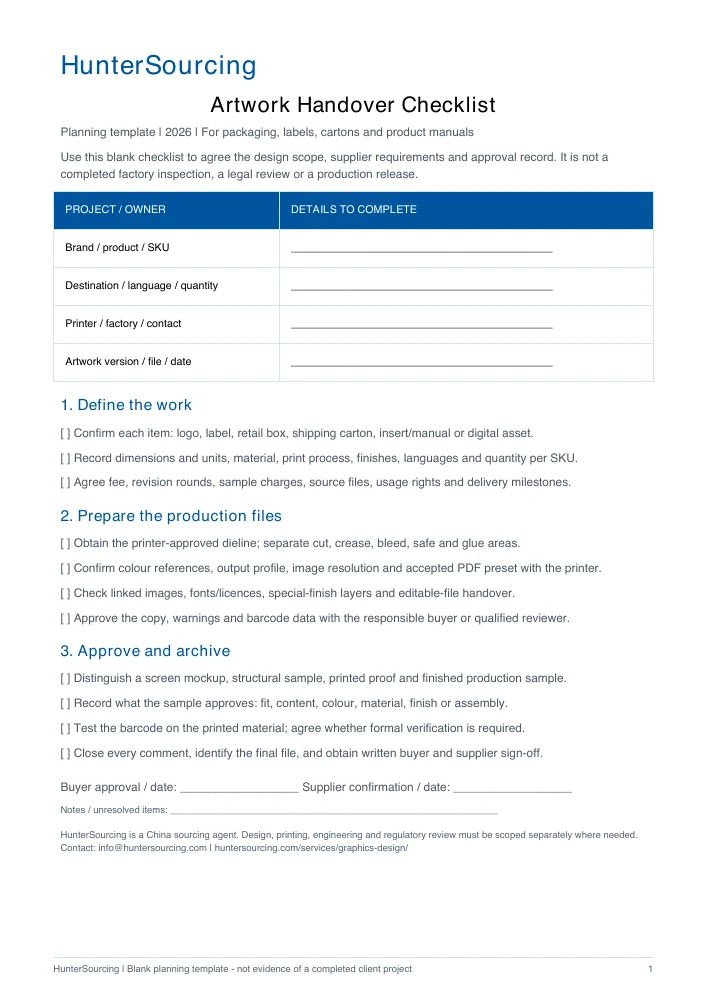
Prepared by the HunterSourcing team. Latest update: 2026. Download the Artwork Handover Checklist (PDF).
Company background: the HunterSourcing company profile describes founder Wen Dao’s export and purchasing work since 2003 and the company’s founding in 2018. For your design project, confirm the named coordinator, designer and printer, and ask for relevant work and agreed responsibilities.
1. Choose the Graphic Design Support You Need
Define what needs to change before asking for a price. Adapting an existing logo to a carton is a different assignment from creating a brand identity or engineering a new product.
| Workstream | Agree the deliverable | Confirm before work starts |
|---|---|---|
| Logo and brand artwork | Logo layout, colour references and export formats | Existing brand assets, permitted use and whether new concepts are included |
| Printed retail boxes | Artwork fitted to the approved dieline (the cut-and-fold template); finish instructions | Product fit, board/material, printing method and who supplies the structural dieline |
| Labels and product graphics | Layout with approved copy, variant data and barcode position | Label dimensions, surface, application and destination-specific content |
| Shipping cartons | Print positions, SKU marks and agreed handling information | Carton specification, packing arrangement and legibility requirements |
| Manuals, inserts and catalogues | Page layout, diagrams and agreed language versions | Final text, technical accuracy, translation and review responsibilities |
| Digital and web graphics | Named image assets and agreed export dimensions | Intended platform, usage rights and whether copy, photography or site development is separate |
| Custom product appearance | Agreed surface graphics and visual references | Industrial design, tooling, engineering and safety validation need their own scope |
If the product or supplier is not yet defined, start with product sourcing in China. For this page, the focus is the design-to-factory handover; supplier selection and order management are separate workstreams.
Who is responsible? Use the project brief to identify your coordinator, designer and printer and record who prepares, checks and approves each deliverable.
| Project role | Responsibility to agree | Record you should receive |
|---|---|---|
| HunterSourcing coordinator | Collect the brief; coordinate questions, versions and supplier handover within the agreed scope | Named contact, scope, open-point log and approval milestones |
| Designer | Prepare the agreed concepts, production artwork and revision package | Named deliverables and revision history |
| Factory / printer | Confirm the dieline, materials, production process and file acceptance | Production specification and proof/sample differences |
| Buyer / brand owner | Approve copy, claims, languages, licensed assets and release decisions | Consolidated feedback and written approval of the named version |
2. Specify the Files Before Comparing Designs
The printer should approve the technical specification before the artwork is finalised. File requirements depend on the substrate, print process, finishing and equipment; an export preset alone does not make a file ready for every press.
| Check | What to record | Reference or acceptance point |
|---|---|---|
| Dimensions and dieline | Finished dimensions, units, cut/crease lines, glue areas and safe zones | Use the factory-confirmed dieline and identify its version |
| PDF and linked assets | Accepted PDF preset, fonts, source files and linked-image package | Adobe lists 300 ppi colour/grayscale and 1200 ppi monochrome image downsampling for several print presets; confirm effective resolution at final size |
| Colour and finishes | Output profile, CMYK/spot-colour references and separate foil/emboss layers | PDF/X-1a and PDF/X-4 have different colour/transparency handling; ask the printer which workflow it accepts |
| Bleed | Printer-specified extension beyond the trim line | Bleed is job-dependent; do not apply a universal value to every packaging structure |
| Barcodes | Code type, data, size, contrast, position and quiet zone | GS1 guidance specifies 4 X-dimensions around QR Codes and 1 X-dimension around Data Matrix / GS1 DataMatrix; these are not universal millimetre values |
| Approval record | Named file, version, copy approval and relevant physical proof | Supplier confirms the same approved revision is released to production |
Technical references: Adobe PDF presets, Adobe bleed guidance and GS1 retail 2D barcode guidance. A successful phone scan is a useful check, but formal barcode verification evaluates more than whether a single device can read the code.
Keep a production-ready PDF and the agreed editable files as separate handover items. Confirm whether fonts, stock photographs, illustrations and other licensed assets can be transferred or need their own licence. Editable files such as Adobe Illustrator (.ai) files are separate from artificial-intelligence-generated images; name the actual software and file extension in the agreement.
Your handover acceptance checklist: tick the items agreed in the quote before closing the design task.
- Editable master artwork in the named software/version, plus a matching production PDF.
- Factory-confirmed dieline, finished dimensions and clearly separated cut, crease and finish layers.
- Packaged linked images and a font/asset list, with transfer or separate-licence requirements recorded.
- Colour references, output settings and the agreed proof/sample reference.
- A SKU-to-file list covering each approved language, size and variant.
- A dated version register and written approval identifying the exact files released to the factory.
Check the files open without missing links, match the approved layout and remain editable as agreed. Ask the printer to confirm its preflight result: preflight is a technical check for file problems before printing. A barcode quiet zone is the clear area around the symbol; keep it free of graphics.
3. Compare Design Quotes, Printing Costs and Revision Terms
Request a scope-based quote rather than comparing a single low design fee. Separate creative work from file adaptation, samples, tooling, printing and freight. Ask who pays when a change is requested after approval.
| Quote line | Make the offers comparable | Frequent cause of extra cost |
|---|---|---|
| Design / adaptation | Number of distinct layouts, SKUs, languages and concepts | A new structure or new concept added to a simple artwork-adaptation brief |
| Revisions | Included rounds, consolidated feedback and change-cutoff point | Additional rounds, new copy or a changed dieline |
| Editable-file handover | Named file formats, linked assets and agreed rights | Source-file release, purchased images or font licensing not included |
| Proofs and samples | Screen proof, structural blank, printed proof or finished sample | Special material, finishing, tooling or sample courier |
| Printing and packaging | Quantity per SKU, material, size, colours, finish and packing | Setup/plate costs or print MOQ hidden in a design-only price |
| Inspection and logistics | Named check, delivery point and responsibility for each charge | Reinspection, repacking, consolidation or freight outside the original scope |
External budgeting context: Upwork’s graphic-designer cost guide displays median hourly rates of US$15–35 and describes a broader US$15–150 range. Those are marketplace figures, not China-specific packaging prices or HunterSourcing rates. Use external hourly figures only as context: compare your project’s itemised scope and total cost, rather than treating an hourly rate as a packaging quote.
HunterSourcing’s fee, payment milestones, revisions and file handover are confirmed in a written project quotation. Design work does not establish the factory’s print MOQ. Ask for quantities and prices per SKU, and compare the total payable amount at each quantity.
Agree revision rules before the first draft. Record the included rounds, what one round covers, who consolidates feedback and the price or approval process for extra work. A changed dieline, extra SKU, new language or new concept can change scope; obtain a written cost and date update before proceeding. Changes after final approval reopen the affected approval steps.
Clarify reuse and rights. List which final artwork and editable files you will receive, when they are released and the agreed reuse rights. Identify stock images, fonts or other third-party assets separately. If you may change factories later, ask whether the handover can be used by a replacement printer without an additional design-file release charge; confirm this in the agreement.
4. Approve the Evidence Before Releasing Production
Ask what each proof actually demonstrates. A screen mockup can help you assess the layout; a structural blank checks fit and assembly; a printed proof checks the agreed print content and process. Record any sample differences that still need approval.
- 1. BriefConfirm product, market, quantities, brand assets and deliverables.
- 2. Production inputObtain the printer’s dieline, materials, process and file requirements.
- 3. Artwork reviewCheck layout, approved copy, variants and the revision record.
- 4. Proof / sampleChoose the sample that tests the unresolved question: fit, print, colour or finish.
- 5. Written approvalClose comments and identify the exact file and sample being approved.
- 6. Production handoverHave the supplier confirm the revision; check production against the agreed reference.
| Record | What it helps you judge | What still needs checking |
|---|---|---|
| Versioned dieline and PDF | Dimensions, layout, file identity and review comments | Physical fit, substrate and the actual print process |
| Structural blank | Folding, closure, fit and assembly | Final colour, printed detail and finishing |
| Production-representative sample | Agreed material, print and finish | Which details differ from bulk production and which tolerances apply |
| Inspection record | Whether the inspected goods match agreed references and checks | Sampling coverage, affected quantity and buyer release decision |
For a colour-sensitive job, agree the physical colour reference, material, lighting and acceptance method with the printer. Do not rely on an RGB screen image as the final colour standard. For the production check, see China quality inspection.
If print, copy or barcode errors are found, record the issue, affected quantity and proposed remedy before release. Agree whether the goods need correction, reprinting or another check, and who authorises the cost and shipment decision. Buyer instructions and supplier responsibilities should remain in the same project record.
A useful project evidence pack contains the approved brief, named designer/printer contacts, file revision log, authorised asset licences, relevant sample photos and written sign-off. Ask to see category-relevant work and confirm the right to share it. Specific label claims, warnings and regulated marks need review by the responsible brand/importer or qualified adviser; a graphic layout is not a compliance approval.
| Issue to resolve | Immediate action | Release condition |
|---|---|---|
| Buyer changes approved copy, language or specification | Identify the changed files and affected stock; obtain the revised scope, cost and dates | Buyer approves the corrected version and any relevant new proof |
| Artwork file differs from the approved brief | Record the discrepancy; ask the responsible designer to correct it and have the printer check the replacement | Corrected file and proof are accepted against the agreed brief |
| Factory output differs from approved files or sample | Document the affected quantity and deviation; hold the affected goods pending the buyer’s decision | Agreed correction, reprint, reinspection or other buyer-authorised disposition is recorded |
Keep the issue, evidence, responsible contact, proposed remedy and buyer decision in one record. Costs and liability follow the agreed terms and the established cause; neither a design correction nor a sample approval automatically decides liability for an entire production run.
5. Plan the Timeline Around Your Approval Milestones
| Milestone | Needed from you / supplier | Output and next-stage condition |
|---|---|---|
| Brief and scope agreed | Buyer: product, markets, SKUs, copy, assets and target date | Named deliverables, revision allowance, responsible contacts and proposed schedule |
| Factory requirements confirmed | Printer: approved dieline, material, process and file specification | Designer works to the confirmed production template |
| First draft and feedback | Designer: agreed draft; buyer: one consolidated comment list | Comments resolved or logged for the next agreed round |
| Proof / sample approved | Printer: agreed proof type; buyer: file, copy and sample review | Written acceptance of the named revision and any agreed differences |
| Release and archive | Coordinator: final version register; printer: receipt and production confirmation | Agreed file package handed over; unresolved issues recorded before release |
Ask for a date and owner for each milestone, including your feedback deadline. Design, sample making, printing and shipping are separate time blocks. Exact days depend on the brief, approvals, material and supplier capacity; confirm them in your project quotation rather than relying on an unverified standard turnaround.
Separate the first artwork draft, revision rounds, structural sampling, print/finish sampling, bulk production and transport. Ask the supplier to confirm dates after the brief and materials are agreed. A delayed copy approval can move the production start even when the designer finishes on time.
| Illustrative buying scenario | Main risk | Useful next approval |
|---|---|---|
| First private-label product: retail box and insert | Approving attractive artwork before confirming product fit and required copy | Product dimensions, approved dieline, copy owner, structural sample and itemised quote |
| Existing range: new language or SKU variants | An old barcode, claim or version being carried into another variant | SKU-to-file matrix, language review, barcode data and version-by-version sign-off |
| Premium gift set: paper bag, rigid box and several suppliers | Different materials or printers producing inconsistent colours and finishes | Shared physical colour/finish reference, supplier-specific samples and a coordinated handover plan |
These scenarios illustrate planning decisions, not completed customer cases. Ask for the sample route and approval time needed for your job rather than treating a generic sampling or production range as a promise. If packaging and goods are made by different suppliers, check the ready dates and packed dimensions before arranging China logistics and consolidation.
6. Graphic Design in China: 10 Buyer Questions
6.1 What should I include in a brief for graphic design services in China?
Provide the product details, target market, approved copy, brand assets, packaging formats, supplier templates and required deliverables. State whether you need artwork adaptation or new branding. Ask the designer to itemize design, translation, revisions, proofs and production coordination, with timing tied to approved inputs.
6.2 Who should supply and approve the packaging dieline?
Ask the packaging manufacturer to supply and confirm the production dieline, including cut, fold, glue and safe areas. Place artwork on a separate layer and clarify ambiguous lines before proceeding. Obtain a revised manufacturer-approved template for structural changes rather than resizing the dieline to fit the graphics.
6.3 Should I send Adobe Illustrator (.ai) source files or a print-ready PDF to the factory?
Agree the factory’s accepted formats and export settings first. A visual mockup, including a Figma layout, still needs a check against the actual dieline, bleed, fonts, effective image resolution and colour settings. Deliver the agreed print PDF and editable files, include licensed linked assets, and keep a matching approved reference. Have the printer check technical file readiness before printing.
6.4 How are packaging design prices and revision rounds agreed?
Ask for an itemised project quote covering layouts, SKUs, languages, concepts, included revision rounds and editable-file handover. Show samples, printing, tooling, licences and freight separately. Confirm what counts as a revision and how extra rounds or changes to approved copy and dielines are priced. HunterSourcing’s charges and terms are confirmed for the agreed scope; external designer rates are not our price list.
6.5 How can I reduce colour differences between my artwork and printed packaging?
Confirm the printer’s output profile, substrate, finish and use of process or spot inks. Record the agreed colour reference and proofing method before production. Approve a suitable physical colour reference where colour is critical; a screen preview alone cannot establish the appearance on the chosen material. For foil, embossing or varnish, agree separate, clearly named finish layers and a reference showing the intended result; confirm achievable detail with the printer.
6.6 How do I keep packaging and label files editable for future SKU updates?
Agree delivery of editable master artwork, linked assets and the applicable font licences. Keep live-text masters separate from outlined production copies, because outlining removes text editing. Track SKU, language, dieline and revision in the file record, and have factory changes returned for approval and archiving.
6.7 Can I change a barcode's shape or placement to fit my label design?
For GS1 barcodes, keep decorative artwork separate; GS1 does not support barcode embellishment. Confirm the correct symbol, quiet zones, contrast, size and placement for the application. Keep the code clear of folds and seams, and request verification of the printed code rather than relying only on a phone scan.
6.8 What should I request when commissioning an English or multilingual instruction manual?
Provide approved instructions, product-specific diagrams and the required languages. Agree who reviews technical wording and translations. Request editable layout files, linked artwork and an approved print PDF. Check page order, font support, missing links and overset text, then test that a reader can follow the instructions using the actual product.
6.9 How long will design, revisions and packaging samples take?
Request separate dates for the first draft, buyer feedback, revision rounds, proof or sample making and the final file handover. Timing depends on the agreed scope, complete copy, the confirmed dieline and supplier capacity. Approve a milestone schedule for your project; no fixed number of days applies to every job. A copy, size or material change can require renewed proofing and a revised production start.
6.10 What should I approve before the factory starts the full print run?
Approve the exact artwork revision, copy, barcode data, structure, material and finish. Agree what each proof validates: a digital PDF cannot demonstrate physical fit or material appearance. Record the approved references and acceptance criteria, identify the production approver, and require renewed approval after artwork or specification changes.
7. Send Your Brief for a Design and Sample Plan
Send your product or reference link, destination market, quantity per SKU, packaging dimensions, existing artwork, language versions, required finishes and target date. Tell us whether you need a new design, an adaptation or a factory-ready file check. A product link and a short brief are enough for an initial discussion; share large or confidential files through an agreed transfer method.
Your next step: we review the requirements, clarify missing inputs and confirm the proposed design deliverables, sample route, charges and approval milestones. You approve the scope before chargeable work starts. Use our Artwork Handover Checklist (PDF) to organise your brief.
Tell Us About Your Artwork and Product
Tell us what you need designed, the product and destination, your current artwork stage and target date. Phone or WhatsApp is optional; use email if you prefer.
Email info@huntersourcing.com or WhatsApp +86 15824350182. Project information is used to respond to your enquiry; see our Privacy Policy. Agree the project response and update schedule during the initial discussion.
Related Articles

Compare corrugated box types, supplier selection and sourcing considerations before confirming carton artwork.
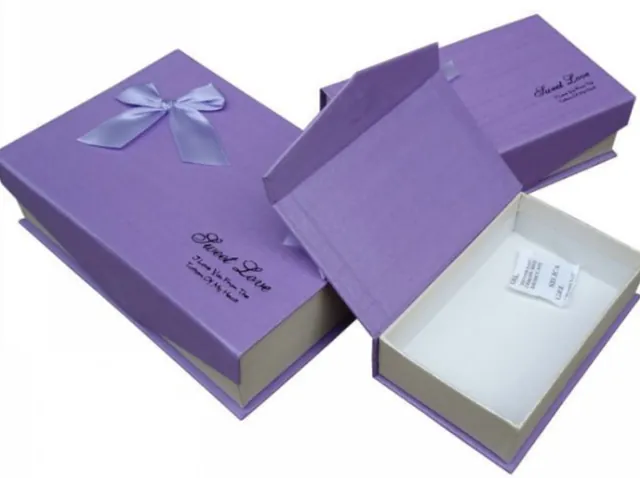
Explore gift-box materials, formats and supplier options when planning a branded packaging project.
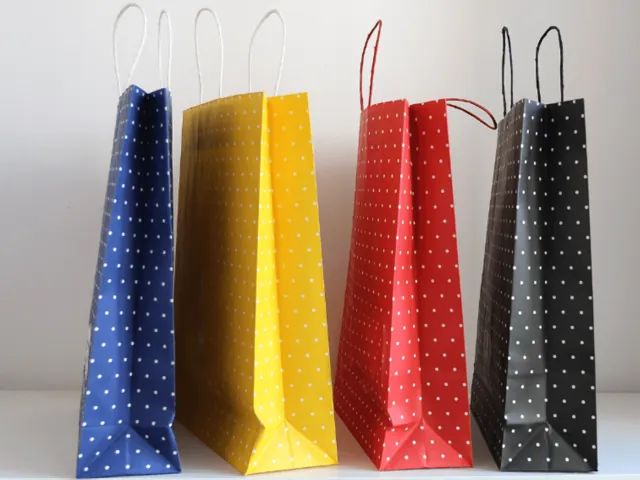
Review paper-bag types, customisation and factory-selection questions before developing printed bag artwork.