
China quality inspection checks an identified production lot against your approved specification, sample, packaging requirements and agreed inspection plan. The useful result is documented evidence for a buying decision: accept, request correction, reinspect or hold dispatch.
HunterSourcing is a China sourcing agent, not a factory. We help buyers define inspection requirements, coordinate checks and follow up supplier findings. Confirm the named inspection provider, product competence, scope and reporting terms in your quotation. A site inspection is not automatically laboratory testing, certification or a guarantee that every unit is defect-free.
1. Choose the inspection stage around the risk
A pre-shipment check can find a problem after production, but it cannot undo a wrong material already used throughout the order. Place checks at the decision points that still allow the supplier to correct the cause. The relevant stage depends on the product, production status and the issue you need to resolve.
| Stage | When to arrange it | What to document | Decision supported |
|---|---|---|---|
| Material / pre-production check | Before the relevant materials or first pieces are committed to bulk production | Material identification, specification version, first-piece measurements and open questions | Resolve substitutions or specification gaps before scaling |
| During-production inspection | When representative output exists and a correction can still affect remaining production | Observed defects, work-in-progress, process observations and corrective-action owner | Correct repeat faults before they spread across the order |
| Pre-shipment inspection | When the agreed finished lot is accessible and its packing readiness meets the booking conditions | Lot identity, random selection, workmanship, tests, packing and quantity status | Review findings before the agreed release or balance-payment milestone |
| Sorting / piece-by-piece checks | When you need to separate nonconforming units or verify specified characteristics across the presented quantity | Units checked, defects segregated, method, rework and limitations | Accept the defined scope of sorted goods; do not infer every possible fault was tested |
| Container loading supervision | After goods release, at the agreed loading location | Container condition, carton tally, visible handling, loading and seal records | Confirm the released goods and loading record; it does not replace product inspection |
Ask the supplier to confirm readiness in writing before the inspector travels. Define what happens if goods are unfinished, inaccessible, already loaded, mixed with another order or unavailable for the agreed random selection. Do not accept an incomplete inspection as an unconditional pass.
2. Build the checklist from your specification
A general checklist helps organize a visit; your order requirements determine the actual pass/fail criteria. Provide the purchase order, model list, drawing version, approved sample or reference photos, destination, quantities and packing instructions. Identify mandatory requirements separately from cosmetic preferences.
| Check area | Specification to provide | Evidence in the report | Boundary to clarify |
|---|---|---|---|
| Identity and quantity | SKU, colour, size mix, lot and carton quantities | Presented quantities, counted cartons, selected cartons and item identification | Counting sealed cartons alone does not establish their internal contents |
| Material and construction | Stated composition, component grade, finish, stitching or assembly requirements | Labels, observable construction, supporting files and any sampled measurement | Appearance or touch does not prove fibre content, chemistry or material grade |
| Size and weight | Measurement points, units, tolerance, GSM where relevant and equipment required | Actual readings against limits, method, sample IDs and photographs | Different measurements may require different sample quantities |
| Function and workmanship | Defined operating checks, reference defects and acceptance criteria | Test steps, observed result, defect location, count and classification | Do not substitute a short on-site function check for endurance testing |
| Branding and packaging | Approved artwork, carton specification, labels and barcode data | Artwork version, label photos, scan results where included and pack condition | Transport simulation or destructive tests need an agreed method and scope |
| Documentation | Exact model and material references for applicable reports or declarations | Files reviewed, issuer, model match and unresolved gaps | A logo or unrelated certificate does not establish conformity of this order |
Define critical, major and minor defects before the visit
Use your product and intended use to classify defects. A defect that creates a safety concern may be critical; a failure that prevents the intended function can be major; a limited cosmetic deviation may be minor. These are working categories, not a universal legal classification. Give the inspector annotated defect examples and an escalation rule for any safety concern.
Make borderline decisions reproducible
Specify the measurement location, lighting or comparison reference where relevant. Record whether a mark is visible at the agreed viewing condition and whether assembly or operation is affected. A named defect example is more useful than a broad instruction such as “good export quality”.
3. Agree the sampling plan, not just an AQL number
A sampling plan determines how units are selected and how the observations inform lot acceptance. Record the lot definition, standard and edition, inspection level, normal or other inspection conditions, defect classes and acceptance/rejection rules. AQL 2.5 alone does not determine how many units to inspect, and it is not a promise that exactly 2.5% of the shipment is defective.
The NIST acceptance-sampling handbook explains that sampling decisions carry both producer and consumer risk. Sampling reduces the amount inspected; it does not establish zero defects in unexamined units.
| Parameter | QIMA published example | How to use it |
|---|---|---|
| Lot quantity | 4,000 units | Define a coherent lot; do not automatically combine unrelated SKUs |
| General inspection level | II | This and lot size establish the code letter in the cited example |
| Code letter / sample size | L / 200 units | Follow the agreed random-selection method |
| Major-defect AQL in this example | 2.5 | Assess other defect classes and mandatory tests separately |
| Accept / reject point for the cited defect category | 10 or fewer / 11 or more defective units | These are sampling decision points for the stated conditions, not a blanket shipping release |
| Sample fraction, calculated | 200 ÷ 4,000 = 5% | 5% describes this example only; it is not a rule to inspect 5% of every order |
Source: QIMA AQL guide and example tables, read 25 October 2026. Its example tables identify ANSI/ASQ Z1.4–2008. Confirm the applicable edition and plan with the provider before booking. The example covers one defect category; unresolved critical findings, missing checks or a mismatched model can still prevent release.
Separate sample quantities by test
The workmanship sample is not automatically the sample for every function, dimension, destructive check or laboratory test. List the number of units for each test, what gets damaged and who supplies replacements. If a required test cannot be performed, the report should say “not performed” and why, rather than recording a pass.
4. Compare inspection costs on a defined scope
Inspection providers often quote per inspector-day. The number of days changes with SKU count, product complexity, test duration, travel, access, sorting quantity and report requirements. A low day rate does not tell you the total cost or which checks fit into the visit.
| Provider and source | Published price / unit | Conditions shown by the provider | Comparison limit |
|---|---|---|---|
| GIO Full Check Service | US$200 per inspector-day | Advertised for major Chinese manufacturing clusters; its page includes report and travel terms | Piece-by-piece scope needs a quantity and time estimate; a day is not unlimited units |
| Asiaction finished-product inspection | US$349 per inspector-day; from US$309 in a package | Its page notes location-dependent travel expenses and adjustments for multiple days | Package eligibility and scope must be confirmed directly; this is not a HunterSourcing offer |
These are two providers’ published references for different service scopes, not a market-wide price range or a like-for-like ranking. HunterSourcing’s current fee, named provider, inclusions and payment terms require a written quotation. Ask for the same checklist, SKU list, location and report deadline before comparing offers.
An inspection budget example
Illustrative arithmetic: at US$349 per inspector-day, two confirmed inspector-days cost 2 × US$349 = US$698 before any excluded travel, laboratory work or other quoted charges. If the order value is US$20,000, that base inspection cost is 698 ÷ 20,000 × 100 = 3.49%. This does not predict avoided losses, guarantee a pass or quote a HunterSourcing project.
| Item | Ask for written confirmation | Why it matters |
|---|---|---|
| Booking and factory readiness | Available inspection date, site address, access contact and readiness condition | Avoid a wasted visit or a report on an incomplete lot |
| Report turnaround | Draft findings, final-report deadline, time zone and review process | Leave time for your decision before pickup or payment |
| Extra checks | Test duration, destructive quantities, equipment, lab coordination and expenses | Keep omitted tests visible instead of treating them as included |
| Payment | Payee, currency, service deposit or prepayment, balance and cancellation conditions | Inspection-service payment and supplier goods payment are separate agreements |
| Rework and reinspection | Supplier corrective-action deadline, who pays and what constitutes a new visit | A correction photo alone may not establish that the full lot has been fixed |
| Logistics release | Who approves release and how the decision reaches the warehouse or forwarder | An inspector does not automatically have authority to release your goods |
5. Turn the report into a release decision
A usable report identifies the exact lot, approved reference, inspection date, presented and sampled quantities, checklist, actual measurements, defect classifications and photographs. It also distinguishes completed, failed, unavailable and unperformed checks. The reader should be able to trace a finding to a sample or carton without guessing which product the photo shows.
- 1. Freeze the specification and checklist
- 2. Record the lot and selection method
- 3. Review findings and open checks
- 4. Record the buyer’s release or hold decision
Use the blank report as a planning aid
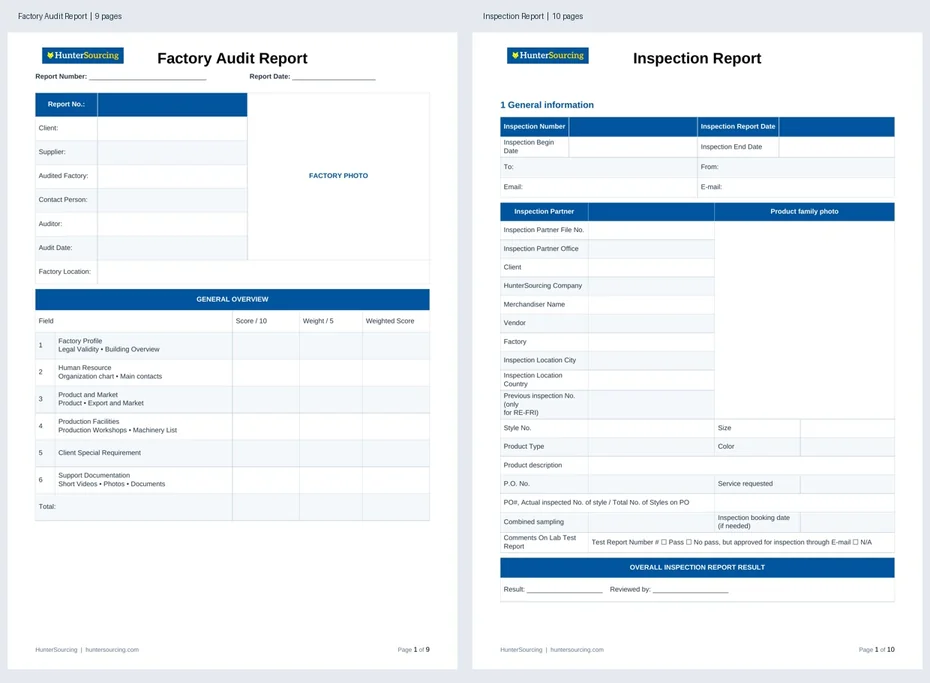
Download the HunterSourcing Inspection Report in Word or the PDF version. Add your lot, measurements, acceptance criteria and required photo evidence before the visit. The template is blank; it is not a completed customer report, inspection certificate or proof that a shipment passed.
6. Failed inspection: correction, reinspection and buyer acceptance
If an inspection identifies nonconforming goods, we report the findings to the buyer and coordinate the next steps with the supplier. There are two main routes: release an identifiable, acceptable portion only when the buyer authorizes it, or hold the affected shipment for correction and reinspection. We keep the inspection follow-up open until the buyer accepts the goods covered by the task or confirms a decision to reject or abandon them.
A small number of observed defects does not automatically make the rest of a shipment acceptable. The agreed inspection plan, defect severity and evidence determine the disposition. A failed random sample does not identify every defective unit in the lot. Before any split shipment, the supplier must separate and identify the proposed release quantity, and the agreed checks must establish that it meets the buyer’s acceptance requirements. Unresolved safety or mandatory conformity concerns must not be treated as acceptable simply because few units are affected.
| Situation | Buyer decision and shipment | Supplier correction and our follow-up | When this route closes |
|---|---|---|---|
| Route 1: A limited portion is nonconforming; most goods can meet the agreed requirements | We report the affected SKUs, quantities and findings. If the buyer requests a partial shipment and gives written authorization, we coordinate release of the separately identified portion that meets the agreed acceptance requirements. Nonconforming or unverified goods remain outside that release. | The supplier separates and corrects or replaces the affected goods. We follow up the corrective action and arrange reinspection when the supplier confirms readiness. The remaining goods require their own inspection evidence and the buyer’s release decision. | The released portion is recorded separately. Follow-up on the remainder stays open until the buyer accepts it or confirms rejection or abandonment of that remainder. |
| Route 2: Most goods are nonconforming, or the affected lot cannot meet the agreed acceptance requirements | We send the findings and evidence to the buyer. The affected shipment is held under the agreed release arrangements while the buyer instructs the supplier on correction, replacement or rejection. We do not release it on our own authority. | The supplier provides a corrective-action plan and completes the agreed work. We conduct a second inspection against the approved requirements and report the new results. If problems remain, we report them again and coordinate further correction and verification as agreed with the buyer. | The task closes only after the buyer records final acceptance of the goods in scope or a decision to reject or abandon them. A supplier’s promise to repair does not close the task. |
Our follow-up workflow, from finding to final decision
- 1. Report and identify. Share the failed requirement, defect evidence, affected lot or SKU, checked quantities and any unperformed checks.
- 2. Record the buyer’s instruction. Confirm a controlled partial release, a hold for correction, or rejection. Identify the exact quantities covered by any written release.
- 3. Correct and reinspect. Follow up the supplier’s corrective action, verify the affected goods when ready and report the results. Repeat the correction and verification loop where needed and agreed.
- 4. Close on the buyer’s decision. Record the buyer’s acceptance or rejection/abandonment, reconcile released and remaining quantities, and retain the inspection and follow-up records.
What the buyer receives at each stage
We keep the original findings, supplier corrective actions, reinspection results and buyer instructions traceable to the same order. For a split shipment, the record distinguishes goods already released, goods awaiting correction and any goods the buyer has rejected. Acceptance of the first shipment does not automatically close follow-up on the remainder.
If a visit cannot finish because goods, access or required equipment are unavailable, we report the incomplete checks and agree how to complete them; we do not record an unperformed check as a pass. Before an additional visit, confirm the reinspection scope, timing, number of visits and any additional charges in writing. Inspection follow-up does not guarantee that a supplier will correct every defect or replace the buyer’s contractual remedies.
| Situation | Evidence to request | Next decision |
|---|---|---|
| A footwear order has a separately identifiable portion with incorrect size labels | Match shoe markings, box labels and carton assortment to the SKU list; identify and separate affected stock, then verify the proposed release portion | If the buyer authorizes a partial shipment, release only the acceptable, identified portion. Follow the remaining stock through relabelling, reinspection and the buyer’s final decision |
| Most of a private-label bag lot differs from the approved bulk-material requirement | Identify the approved sample version, affected lot, supplier declaration and any necessary material test; do not infer composition from appearance | Report to the buyer, hold the affected lot under the agreed arrangements, follow the supplier’s correction and reinspect before the buyer accepts or rejects it |
| Flat-pack furniture arrives for inspection without the required assembly tools | Record which assemblies and functions were not checked and why | Arrange access or equipment and complete the omitted checks; do not convert “not tested” into “pass” |
7. Keep inspection separate from supplier selection and shipping
A factory assessment looks at a supplier and its capabilities; a product inspection examines identified goods. Supplier selection and sample comparison belong in our product sourcing service. For the wider project scope and fee structure, see China sourcing services. After the buyer’s release decision, confirm the handoff to the logistics service.
Laboratory testing and product-conformity work need the exact model, destination, method and competent provider. We do not use another company’s accreditation as a HunterSourcing credential. Ask who will inspect or test, what evidence they can provide for that scope and how potential conflicts of interest are handled.
China quality inspection FAQs
Can HunterSourcing inspect an order from a supplier I already use?
Send the supplier address, product specification, quantities, production status and required checks. We will clarify the proposed scope and named inspection provider. An existing supplier relationship does not remove the need for access, approved references and a written checklist.
Which inspection stage should I choose?
Choose the stage around the risk you need to control. Material or first-piece checks address early deviations; during-production checks support corrections before the batch is finished; pre-shipment inspection supports a lot-release decision. Loading supervision records loading and does not replace product checks.
Does AQL 2.5 mean that 2.5% of my shipment is defective?
No. AQL is an input to an agreed acceptance-sampling plan. Lot size, inspection level, the applicable tables and defect category determine the sample and decision points. Sampling does not measure the exact defect rate of all unexamined units.
Will every unit be checked?
Only if a defined piece-by-piece scope is agreed. A random-sampling inspection checks selected units. Even a piece-by-piece service covers specified characteristics and methods; it does not prove that every possible failure mode was tested.
How much does China quality inspection cost?
Obtain a written quote stating inspector-days, location, SKU count, checklist, tests, report deadline and extras. Published provider day rates are comparison references only. HunterSourcing fees, payment, cancellation and reinspection terms are confirmed for the specific booking.
How quickly will I receive the report?
Agree the final-report deadline and time zone before booking, alongside factory readiness and the planned dispatch date. Leave time to review defects and complete any correction or reinspection. No universal report or booking deadline applies to every project.
Does an inspection report replace certification or laboratory testing?
No. On-site observations, sampling, laboratory tests and conformity documentation answer different questions. Confirm the exact model, test method, issuer and destination requirements. A blank template or unrelated certificate does not establish compliance of your goods.
What happens if the inspection fails or required checks are missing?
We report the findings and follow the buyer’s instructions. An identifiable portion that meets the agreed requirements may ship only with the buyer’s written authorization; affected goods remain for supplier correction and reinspection. If most goods fail, the affected shipment is held under the agreed arrangements while the supplier corrects it and we conduct a second inspection. Further follow-up remains open until the buyer accepts the goods in scope or confirms rejection or abandonment. Incomplete checks are reported as incomplete, not passed.
Request an inspection plan for your order
Send the product or SKU list, supplier location, quantities, production status, destination and target inspection date. Attach your specification and approved sample references through your agreed project channel. Ask about sample collection if you need production samples for an independent review; courier and sampling costs require confirmation.
WhatsApp / WeChat: +86 15824350182. Email: info@huntersourcing.com. We use enquiry details to assess and respond to your request; read our privacy policy. China office hours: Monday–Friday 09:00–18:00; Saturday 09:00–17:00. Availability and inspection dates are confirmed for each project.
Related Articles
 China Sourcing Services: Factory Audit, QC & Shipping
Agree the scope, commercial terms and coordination needed around supplier checks and order execution.
 Product Sourcing China: Supplier Search, Quotes & Samples
Prepare a supplier shortlist, comparable quotations and approved samples before production inspection.

Plan consolidation, freight and the handoff of goods after the buyer’s release decision.