

Cat Litter Manufacturer in China: OEM & Private Label Guide
China sourcing | Cat litter OEM and private label | Buyer’s guide
How to choose a cat litter manufacturer in China
Match the factory to the target market, litter formula, bag format and order size, then prove the specification with a controlled sample. Verify the legal seller and production site, separate the litter MOQ from the printed-bag MOQ, and compare every offer on the same net weight, Incoterm and delivery scope. HunterSourcing is a China sourcing agent, not a factory; we help importers research suppliers, coordinate samples and follow up orders through our product sourcing service.
Use this guide to build a comparable shortlist for bentonite, tofu, cassava, pine, silica or blended litter. Supplier figures are attributed to their publishers and need project-specific confirmation.
- Define the material for the target shelf and use case.
- Separate product MOQ, scent / design MOQ and printed-bag MOQ.
- Compare cost per net kilogram on one Incoterm, including the sourcing service fee.
- Approve a production-intent sample and a written bulk acceptance plan.
1. China cat litter manufacturers to investigate
The right shortlist depends on the product route, not a generic “top ten” label. Start with suppliers whose official websites describe the material, packaging route and commercial terms your project needs. Then verify the legal entity, production site and exact model. The table is a research starting point; it is not a ranking, a HunterSourcing audit register or evidence that every public claim has been independently checked.
| Candidate / official source | Published role and location | Product scope | Published MOQ / packing reference | Evidence to verify for your order |
|---|---|---|---|---|
| Kind Pet | Dalian headquarters; production in Inner Mongolia and Shandong is stated | Bentonite, tofu, cassava, pine, green tea, coconut and blends | Publishes 1 container as MOQ and 25 years, 80+ countries, 40,000 t/month | Confirm legal entity, line-by-line site link, exact formula, current COA and support for each public claim |
| Richeast | Manufacturer and exporter since 2015; production site still needs project verification | Tofu, bentonite, mineral and mixed litter | 500 kg tofu; 5 t bentonite; 1 t mineral / mixed; 1 t per OEM SKU | Samples 3 working days; production 7-18 days; 30% deposit, balance against shipping documents |
| SAJMAO | Supplier / manufacturer presentation; legal production address to verify | Tofu, bentonite and mixed litter | Tofu: 5 t; lists 1.5, 2.0 and 3.0 mm options and published absorption / dust claims | Obtain exact model specification, test methods, batch COA and written sample / lead-time terms |
| Hanlong / Gilancy | Qingdao Hanlong manages contract and export; wholly owned Gilancy is named as factory operator | Cassava, tofu, cassava-tofu, cassava-bamboo and mineral blends | 10,000 printed bags per design / size; 2,000 cartons per size | 25-30 days after confirmation is published; verify sample metrics, line identity, loading plan and current artwork approval |
| HaisenPet | China-based exporter / manufacturer presentation; site to verify | Tofu, bentonite, crystal and cassava products | Tofu 1 t; crystal 2 t; bentonite 5 t; custom bags 6,000 / 5,000 / 3,000 pieces for 5 L / 10 L / 25 L | Tofu 15-30 days and customized 25-40 days are published; confirm product and bag MOQ together |
| RootPurr | Xingtai, Hebei presentation for US private-label programmes | Plant-based cassava, tofu and blends; states no bentonite | Sticker route 50 cases; custom bag 1 FCL about 25 t; custom formula 1 FCL | 18-25 / 30-45 / 37-55 days for the three routes; sample bag 7-14 days; verify third-party report and current quote |
Use the same questions for every candidate: Who signs the contract? Which factory and line make the goods? Which formula and bag version are quoted? Are the quoted MOQ and lead time conditional on stock packaging, artwork or a new formulation? Supplier websites can show capability; a project quotation and retained evidence establish what is being offered. Our supplier search and quotation comparison service explains how this evidence can be organised.
2. Match the litter material to the buyer’s market
Choose the material by the product experience, target price and route requirements. Bentonite, tofu, cassava, pine, silica and blends behave differently in clumping, density, dust, packaging and disposal. The same category name can cover different formulations. Record the actual material composition and test conditions instead of accepting “premium” or “dust-free” as a specification.
| Material | Typical market fit | Specify and measure | Commercial or performance risk |
|---|---|---|---|
| Sodium bentonite | Heavy-duty clumping and broad retail familiarity | Sodium vs calcium grade, granule distribution, moisture, absorption method, clump strength | High density affects freight and container payload; freight per kg can outweigh a lower mineral cost |
| Tofu (pea or soy based) | Plant-based positioning and lower density for some routes | Declared fibre and starch source, binder, pellet diameter, moisture, dust, absorption and clump method | Flushable and biodegradable wording require product-specific evidence and destination rules |
| Cassava / tapioca | Plant-based fine-grain or value-positioned ranges | Ingredient percentage, binder, colour, pellet size, bulk density, clump and dust method | A cassava blend is not automatically the same product as tofu; lock the formulation and ratio |
| Pine or wood | Low-density natural positioning; often non-clumping | Species, moisture, pellet dimensions, fines, storage and disposal route | Check source, packaging barrier and how the product behaves after transport |
| Silica gel | Moisture control with a crystalline, non-clumping format | Composition, crystal size, dust method, colour additives and packaging | Do not describe silica as clay; verify destination labelling and handling requirements |
| Blended litter | A balance of performance, texture and cost | Every ingredient and percentage, granule-size distribution, segregation after handling | A uniform sample can separate in transit; test the blend after transport simulation |
Do not treat a volume in litres as a fixed mass in kilograms. Bulk density differs by formula and process, so the same 10 L bag can have a different net weight. Ask for the measured density, tare weight and net-fill check for the exact product.
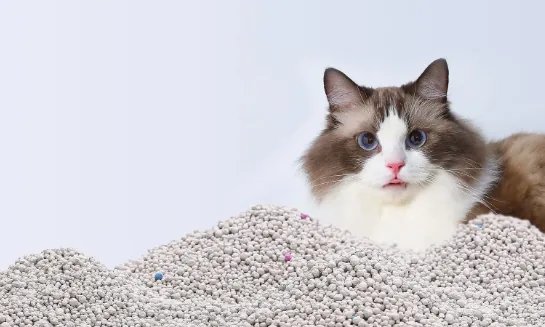
3. Turn the product brief into a measurable specification
A useful specification states the method as well as the target number. A supplier’s dust, absorption or clump value cannot be compared with a different test method. Agree the sample size, liquid volume, contact time, sieve and acceptance limit before the supplier sends the sample.
| Field | What to define | Why it matters |
|---|---|---|
| Formula / ingredient percentages | Signed formula sheet and supplier declaration | A visual match cannot lock fibre, starch, clay grade or additives |
| Pellet or granule size | Sieve stack or image measurement with stated sample size | One photograph cannot show the particle-size distribution |
| Moisture | Oven or supplier-agreed laboratory method, reported units | High moisture can reduce shelf stability and create bag or transport problems |
| Dust / fines | State sample weight, sieve, shaking time and result | Dust percentages from different methods are not directly comparable |
| Absorption | State liquid type, volume, contact time and test temperature | The number should reproduce the conditions the buyer will use |
| Clump strength / breakup | Agree newtons or drop / lift method, liquid dose and timing | A harder clump is not always the target; scooping and breakage behavior matter |
| Bulk density | kg/L or g/L using a defined fill and settling method | Litre and kilogram labels are not interchangeable; density affects bag fill and loading |
| Bag fill | Calibrated scale, target net weight, tare and permitted tolerance | Net-weight shortages and overfills create commercial and packaging risk |
| Bag film and seal | Film structure, thickness, closure, seal strength and drop / handling test | A digital mockup does not prove filling, sealing or transport performance |
| Odour, fragrance, colour and additives | Reference sample, dosage limit and blind sensory test if relevant | Scent and additive claims need a known composition and an approved sensory reference |
| Batch identity and storage | Batch code, COA link, production date and storage conditions | Traceability is needed when a defect or claim appears after delivery |
Write the approved version into the purchase order and attach a dated sample record. If the factory changes a raw material, binder, scent, pellet die or bag supplier, reopen the affected checks. Record which functions were not tested so an untested claim does not become an accepted requirement.
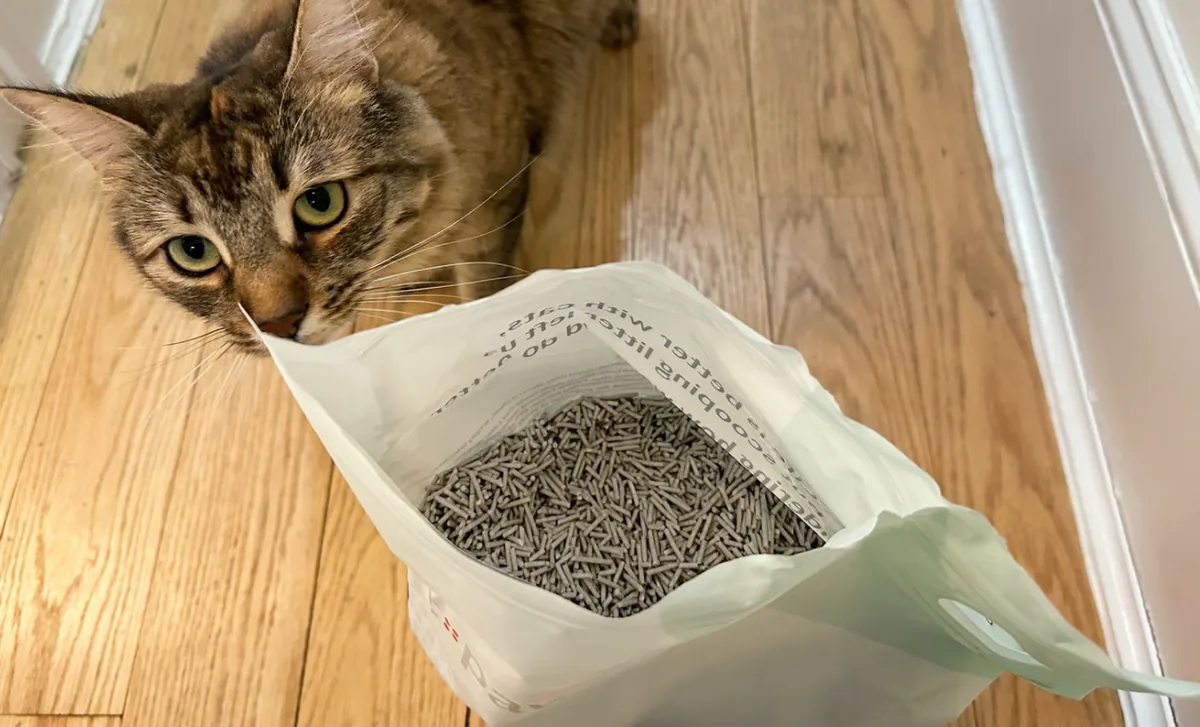
4. Compare MOQ, packaging and production milestones
The effective order minimum is often the higher of the litter MOQ and the packaging MOQ. Published supplier examples show why a single blanket number is misleading. One supplier may quote a 500 kg tofu trial while another requires 5 tonnes, and a custom-printed bag may require thousands of pieces per design. Ask for each threshold separately, then calculate the number of bags your planned quantity produces.
| Route | Published reference | Why the route differs | What must be written into the quote |
|---|---|---|---|
| Stock bag + sticker label | RootPurr publishes 50 cases for its stock-brand route | The product is already packed; the setup and bag minimum change | Confirm label approval, carton count, net fill and whether the stock bag remains available |
| Standard formula + custom printed bag | RootPurr: 1 FCL approx. 25 t; Hanlong: 10,000 bags per design / size | Printing, bag construction and artwork can dominate the effective MOQ | Quote formula and bag separately; identify which party owns plates and unused bags |
| New formula or custom scent | RootPurr: 1 FCL; sample bag 7-14 days; bulk 37-55 days | Development, sensory approval, ingredients and packaging create extra stages | Approve formula and packaging versions; add development time and fees to the schedule |
| Small tofu trial | Richeast: 500 kg first order; SAJMAO: 5 t | Different suppliers set different trials and may use different pack formats | Do not treat one published MOQ as an industry minimum; request your exact formula and bag |
| Bentonite trial / full container | Richeast: 5 t first order; dense product may reach weight limits before cube limits | Material density, pallet pattern and route payload change the plan | Ask for net / gross weight, bag count and a loading drawing; confirm the route limit |
| Per-SKU private label | Richeast: 1 t per OEM SKU; printed bags may have their own minimum | Scent, colour and bag design can create separate SKUs | Get MOQ by SKU, by artwork and by delivery milestone in one written offer |
Two transparent calculations: 1,000 kg divided by 2.5 kg per bag equals 400 bags. 25,000 kg divided by 2.5 kg equals 10,000 bags. These calculations use an assumed net fill and do not prove that a supplier will accept either quantity. Confirm the bag size, fill tolerance and exact packaging minimum.
Separate four dates: sample-ready, artwork / packaging approval, goods-ready and shipment. A 3-day sample dispatch is not a 3-day production commitment. A 25-30 day production period is not the ocean transit time. The project schedule should identify which event starts each clock and which party owns each dependency. Once production is ready, compare China logistics options using weight, pallet and route data.
5. Compare the full acquisition cost
Compare the same formula, quantity and delivery basis before you look at the lowest unit price. A cheaper bag or an omitted inspection or freight charge can reverse the ranking. Include the sourcing service fee in one transparent line and remove any charge already included in another line.
| Cost field | Define consistently | Evidence to retain |
|---|---|---|
| Litter goods | Same formula, granule size, net fill, quantity and Incoterm | Factory invoice or dated quotation with line items |
| Bag / carton / plates / setup | Specify film structure, dimensions, print colours and ownership of plates | Packaging offer; do not add a setup line twice if already included |
| Samples and courier | Sample quantity, stock or customized version, courier account and customs treatment | Sample invoice and tracking confirmation |
| Testing and conformity | Test methods, laboratory, sample identity and report owner | Report / quotation; generic certificates are not a substitute |
| Sourcing agent service fee | Fixed or percentage basis, tasks, exclusions, minimum charge and tax | Separate HunterSourcing invoice; disclose any supplier commission or rebate |
| Inspection / reinspection | Checklist, lot size, sampling plan, AQL or defect rules and report scope | Inspection agreement and approved report |
| Freight and insurance | Port pair, routing, weight / volume, pallet, schedule and validity | Forwarder quotation; distinguish origin, ocean and destination charges |
| Duty, tax and delivery | Destination rules, recoverable tax, customs broker and last-mile scope | Importer or broker calculation; not a supplier promise |
| After-sales / replacement | Who receives evidence, who pays freight and what remedy is allowed | Written claim and replacement terms |
Total acquisition cost = litter goods + packaging / setup + samples + testing + sourcing service fee + inspection + freight / insurance + applicable import costs + agreed after-sales allowance. Add only charges that are not already included. State currency, quantity, named Incoterm place and quote validity beside the total.
Do not apply an assumed discount to a public price range. Request a dated quote for the exact formula and quantity, ask for the next quantity break, and compare cost per accepted net kilogram. For a retail pack, calculate the cost per saleable bag using the actual net fill and the agreed packaging allowance.
6. Approve samples and control the bulk release
Approve the production-intent sample, not a showroom sample that uses another formula or packaging line. Record the formula revision, physical bag, label, test method and results. Photographs support the record but cannot replace measurements.
| Check | Record before approval | Evidence |
|---|---|---|
| Sample identity | Serial or sample ID, formula revision, date, supplier and intended bulk line | Photo of label and sealed retained sample |
| Files and settings | Test method, laboratory, operator, instrument if relevant | Method version and raw result |
| Granule / pellet | Sieve result, sample size and distribution | Chart or table, not only a photograph |
| Moisture / density | Agreed method, temperature, units and replicate count | Recorded values and calculation |
| Absorption / clump | Liquid type, volume, contact time, lift or drop method | Actual result, pass / fail and observed breakup |
| Dust / fines | Sieve size, sample mass, shaking method and duration | Result and collected fines photo |
| Bag and label | Physical bag version, film, seal, fill weight, barcode and language | Approved artwork and bag sample |
| Decision | Accept, revise or reject; who signs and when | Dated buyer approval and open issues |
- 1. Verify
Entity, factory, formula and quoted line - 2. Freeze
Specification, sample, bag and label version - 3. Test
Use one written method and acceptance limit - 4. Inspect
Match the bulk lot to the approved reference - 5. Release
Buyer decides each affected quantity
If a small or contained part of the lot fails, the buyer may authorize release of only the identified acceptable quantity while the supplier corrects the remainder and submits it for another check. If a large portion fails, report the findings to the buyer, arrange supplier corrective action and reinspection, and keep the affected quantities open until the buyer accepts, rejects or documents another final disposition. A partial shipment does not close unresolved goods.
For a post-delivery complaint, preserve unopened bags, batch codes, photographs and the test record. Agree the evidence required, return authorization, examination location and responsibility for parts, product, freight and duties before offering a replacement or credit. Our China quality inspection service explains how an agreed checklist and findings can support a release or correction decision.
7. Match documents to the actual product and destination
Ask for evidence that names the company, formula, batch, model or packaging actually ordered. A general certificate page is not enough. ISO 9001 is a management-system certificate; a batch COA is a product record; an SDS describes composition and handling; a third-party report covers the sample and method identified in that report.
| Document | Match it to the order | What it does not prove |
|---|---|---|
| Business licence / legal entity | Legal name, registration, address and signatory | Does not prove production capability |
| Factory identity / production site | Contracting entity, factory operator and quoted line | A trading company can coordinate a valid order, but the quality owner must be written down |
| ISO 9001 certificate | Certified scope, site, issuer and validity | Management-system evidence, not a batch product test |
| Batch certificate of analysis | Formula or batch, test methods, results and date | A COA is only as useful as its traceability and test methods |
| Third-party laboratory report | Sample identity, laboratory, method and report scope | A submitted-sample result does not prove every future lot |
| Safety data sheet | Composition and handling information for the offered material | Not a general safety approval or customs guarantee |
| Packaging and label file | Artwork version, dimensions, barcode, language and fill | A digital proof is not a physical bag approval |
| Destination-market file | Importer, broker or competent lab assessment for the exact formula and claim | Requirements vary; do not copy a certificate list from another product category |
Certification depends on the product, intended use and destination. CE marking applies only to product categories covered by the relevant EU rules; do not put a CE badge on cat litter merely because another pet product uses one. Ask the importer, customs broker or a qualified compliance provider to identify the applicable rules and evidence for your exact formulation and packaging.
8. Three buying scenarios and the next decision
Use the numbers to expose the real constraint before paying for samples. The following are planning examples, not customer cases or achieved results.
| Scenario | Arithmetic / constraint | Next decision |
|---|---|---|
| 1,000 kg tofu trial in 2.5 kg bags | 400 bags before damage or samples | Ask whether 500 kg is available and whether stock bags with labels avoid a 10,000-piece print run |
| 10,000 bags across two scents at 2.5 kg | 25,000 kg total; 5,000 bags per design on a split | A 10,000-bag per-design minimum is not met; consolidate the first SKU or request another print method |
| Compare three formulas on one protocol | Same liquid, dose, timing, granule size and bag format | Choose the formula whose measured performance fits the market and total landed cost |
What HunterSourcing can coordinate
Send a reference product or formula brief, target market, net fill, estimated quantity and required launch date. We can organise supplier research, comparable RFQs, sample collection, evidence tracking and agreed inspection or logistics steps. Tell us what you already manage so the scope and fee are explicit; inspection, freight and testing may be separate services.
Download the cat litter sourcing worksheets
Download the printable cat litter RFQ and acceptance worksheet (PDF) or download the CSV specification worksheet. These blank planning tools do not contain a supplier quotation, laboratory result, certificate or customer case.
Cat litter manufacturer FAQs
How can I verify a cat litter manufacturer in China?
Match the supplier to your intended material, capacity and market, then check the contracting legal entity and the actual production site. Ask which processes are performed on site or subcontracted, request current product-specific documents, and verify the factory and sample controls before a deposit. A catalogue or trade profile alone is not proof of an audit.
Should I choose tofu, bentonite, silica or mixed cat litter?
Compare each proposed formula against the intended customer, price, packaging and disposal requirements. Request samples and consistent tests for clumping, dust, odor control, tracking and moisture; experiences vary by formulation and use. Ask for the ingredient composition and confirm that the exact product meets the rules in the destination market.
Why do cat litter clumps break, and how can buyers compare them?
Clumping performance can vary with the formula, liquid amount, contact time and handling. Agree a repeatable test with the same sample quantity, liquid, waiting period and handling method, then compare approved samples with production lots. Record the results and acceptable tolerances rather than relying on a sales description.
How can I verify a low-dust cat litter claim?
Ask the supplier or a qualified laboratory for a test report covering the exact formulation and particle size, including the method, handling conditions and measured result. Compare samples using the same procedure and check bulk lots against the agreed limit. Do not assume that low dust means completely dust-free.
How should I assess odor control and fragrance?
Compare samples under the same documented conditions and record the test duration, material, odor source and result. Ask which fragrance or odor-control ingredients are present and request supporting evidence for any claim. Odor perception and performance vary by use, so a fragrance alone is not proof of longer-lasting control.
What affects tracking, and will the litter work in automatic boxes?
Granule or pellet size, shape, moisture, litter depth and the box design may affect tracking and compatibility. Ask for the particle-size distribution and test samples in the intended type of litter box, including any automatic unit. Confirm compatibility and performance for the specific model before making claims.
Can tofu cat litter be flushed or composted?
Do not assume that a plant-based or water-dispersible litter is suitable for flushing or home composting. Consult the destination waste and wastewater authority: for example, Metro Vancouver advises against flushing litter. Request the evidence and local guidance relevant to any disposal claim for the exact product.
What are the MOQ and packaging options for private-label cat litter?
Ask for separate minimums by formula, scent, pack size, printed-bag design and order. Supplier examples in this guide include a 500 kg tofu trial and higher minimums for other product routes; they are not universal offers. Confirm sample and artwork charges, packaging quantities and the final quotation for your own SKU.
How do I compare costs, samples and delivery times?
Request quotes for the same formula, net weight, quantity, packaging, currency and named delivery term. Separate samples, tooling or artwork, goods, inspection, service fees, freight and destination charges. Agree dates for sample approval, packaging readiness, production and inspection; published supplier lead times vary and are not a delivery promise.
What documents and inspection evidence should I request before shipment?
Ask for the business licence, relevant product and packaging specifications, current batch certificate of analysis and test reports for the exact formula, batch and destination as applicable. Compare production against the approved sample using agreed test methods and defect limits. Record any failed quantity, correction and reinspection; the buyer decides whether to accept, release or reject goods under the written agreement.
Get a cat litter quote and sample plan
Send your destination, material, bag size, estimated first order and packaging requirement. Add a reference sample or specification if available. Ask us to compare suppliers, request a same-basis RFQ and define the sample checks before you commit.
Email info@huntersourcing.com. WhatsApp / WeChat: +86 15824350182. Enquiry details are used to assess and follow up on your request; see our privacy policy. Confirm the response schedule with your project contact.
Prepared by the HunterSourcing sourcing team
This guide is published by HunterSourcing, a China sourcing agency based in Haining, Zhejiang, founded in 2018. Our company profile describes supplier research, sample coordination, order follow-up and quality inspection services. For your project, ask for a named contact, the proposed deliverables, fee basis and examples of relevant evidence. We do not claim that the companies in the shortlist have been audited, endorsed or exclusively partnered with HunterSourcing.
Supplier pages and industry references were checked on 25 October 2026. Public figures remain the publishers’ statements and may change. The buying scenarios, material guidance and blank worksheets are planning tools; they are not a promise of a supplier’s MOQ, price, lead time, certification or delivery result.
Related Articles
 Best Chinese Cat Food Manufacturers: A Complete 2026 Guide
Review cat food sourcing, supplier questions and quality considerations for a pet product range.
 Pet Food Manufacturer in China: OEM, MOQ & Quality Checks
Compare pet food OEM scope, minimum orders, samples and quality checks before requesting a quote.
 How to Import Wholesale Pet Supplies from China Effectively
Understand supplier selection, product consolidation and importing steps for a broader pet supplies order.
Related Post

Furniture is a must for an office or a home. It is available at varying price points as Read more
Wood is extensively used in making furniture around the world. Wood can be molded in any shape or Read more

China offers many types of sofas at an affordable price. When it comes to Chinese Sofa Manufacturer, This Read more
Get Free Quote

Contact Us Get Free Quote!
* Please kindly fill out the form for inquiry
* we will reply to your inquiry within 24hours