

Wholesale Fabric Market China: A Buyer’s Sourcing Guide
CHINA FABRIC SOURCING · MARKET-TO-ROLL BUYER GUIDE
Choosing a wholesale fabric market in China starts with the fabric and the repeat-order requirement. Compare Guangzhou’s Zhongda cluster for apparel-oriented discovery with Keqiao’s broad textile supply network; investigate Haining/Xucun for home-textile fabrics and specialist mill routes when the material or finish requires them. A market address helps you find sellers. The approved specification, sample and offered dye lot determine what you actually buy.
Need help comparing stalls, collecting samples or checking rolls before export? HunterSourcing is a China sourcing agent that can coordinate those tasks within an agreed scope. We help organise a comparable buying brief and a documented release decision.
Start with composition, construction, GSM, usable width, colour, quantity and destination. A reference swatch is useful even if your specification is not finished.
Prepared by the HunterSourcing sourcing team · Public references checked 27 October 2026 (Beijing). Market examples are sourcing starting points, not endorsements of individual sellers or claims of our own production capacity.
1. Choose a fabric market for the job you need done
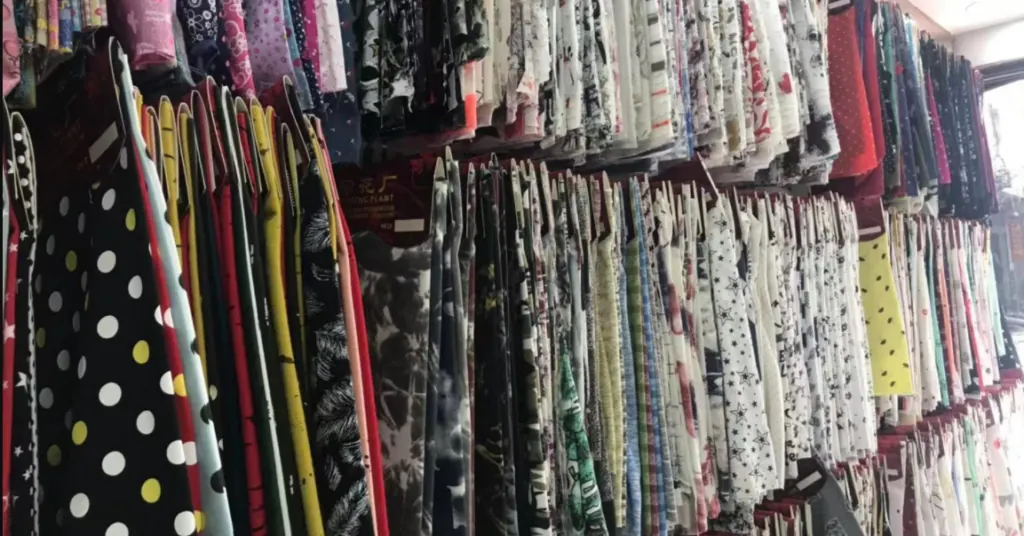
Shortlist by end use, then confirm the actual seller and production route. Buying a small stock roll for sampling differs from commissioning a repeatable colour programme. The comparison below is an editorial planning framework, not a guaranteed ranking of price, stock or quality.
| Market / cluster | Useful investigation | Before a visit or order |
|---|---|---|
| Zhongda cluster (中大纺织商圈), Haizhu, Guangzhou | Apparel fabric and accessory discovery, side-by-side swatches and coordination with a Guangdong garment programme. | This is a district containing multiple complexes, not a single floor directory. Ask for the exact building, Chinese address, stall, contact and sample code. Confirm business hours and current stock. |
| China Textile City (中国轻纺城), Keqiao, Shaoxing, Zhejiang | Broad fabric discovery and access to merchants and the surrounding textile supply chain. | Match the fabric family and process to the seller. Verify whether the business is a mill, trader or converter and where weaving/knitting, dyeing and finishing occur. |
| Shengze / Chinese Oriental Silk Market, Wujiang, Suzhou, Jiangsu | A textile and silk-industry cluster to investigate for specialist material and processing briefs. | Do not infer fibre composition from the word “silk” in a market name. Confirm the exact yarn, construction, finish, production site and repeatability. |
| Haining / Xucun (海宁 / 许村), Zhejiang | Home-textile, curtain and upholstery fabric development and supplier comparison. | Verify usable width, pattern repeat, backing, colour lot, end-use performance and whether you are buying cloth or a finished item. |
| Dieshiqiao (叠石桥), Nantong, Jiangsu | Home-textile and bedding programmes, including comparison of fabric supply with finished-product sourcing. | Clarify whether the quotation covers fabric rolls, cut panels, filled products or complete bedding sets. Quantities and inspection criteria are different. |
Official regional sources confirm the underlying clusters: Haizhu’s description of Zhongda, Zhejiang’s China Textile City profile, Suzhou’s Shengze profile, Xucun’s textile overview and Nantong’s home-textile industry update. These establish locations and industry context; they do not certify a particular vendor.
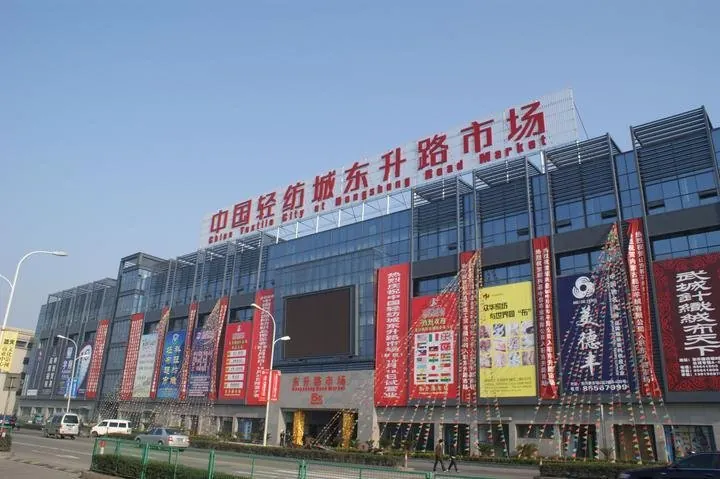
For scale only, Zhejiang’s April 2025 profile reports China Textile City was founded in 1988, renamed in 1992, and had 38,000 vendors as of 2024 across 3.9 million m². These dated figures describe the market, not a current supplier count we have audited, and not a reason to accept an untested lot.
Zhongda: plan a cluster visit, not a seven-floor itinerary
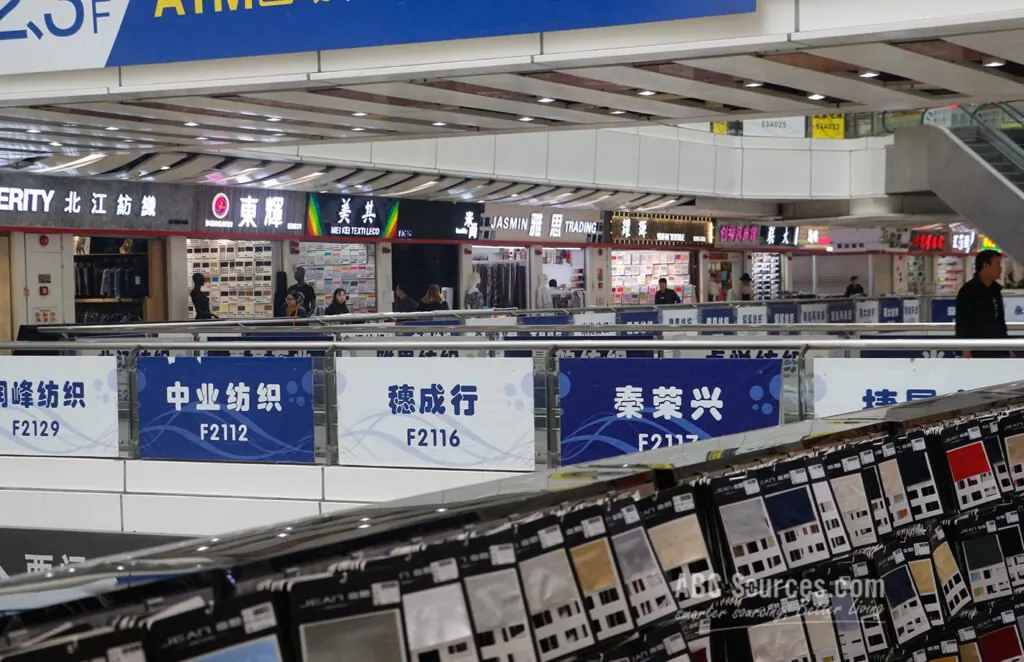
The old idea of assigning the same product to a numbered floor throughout Zhongda can send you to the wrong building. Use exact complex and stall names. Record each swatch with the supplier’s item code, legal trading name, quote unit, available colours, stock status and claimed production route before moving to the next shop.
If your trip combines fabrics with other categories, use our Guangzhou wholesale market guide for the wider itinerary. This page stays focused on the fabric-to-roll purchase decision. Check closures, relocations, holidays and appointments directly before booking travel.
Keqiao: connect the sample to a repeatable supply route
Ask who owns the fabric specification and who can reproduce it after the sample lot sells out. A merchant can be a useful route to several mills, but keep the trading and production roles visible. For a recurring programme, investigate process control, shade continuity, reserved material and re-order terms as well as the first quote.
2. Prepare a fabric RFQ that sellers can quote consistently
A fabric name or photograph alone does not define an order. Ask each vendor to quote the same construction, measurable limits and colour reference. Mark unknown values as questions instead of silently letting each seller substitute a different specification.
| Field | Write in the RFQ | Acceptance evidence |
|---|---|---|
| Fibre and construction | Fibre percentages; woven/knit/nonwoven; weave or knit structure; yarn details if critical. | Approved specification and composition test if required. Do not treat appearance or a recycled-content marketing claim as a composition result. |
| Weight and usable width | GSM, usable width in cm, agreed tolerances and how/when measured; exclude unusable selvedges where applicable. | Representative measurements after agreed conditioning; record actual values and the test conditions. |
| Colour and pattern | Physical standard or colour reference; lab dip; print artwork, repeat, direction and licence/permission. | Signed or otherwise traceable approved reference; agreed lighting and shade criteria. Screen colours are not an approval standard. |
| Performance | Shrinkage, colourfastness, pilling, abrasion, stretch/recovery, finish durability or another relevant requirement. | Specify test method, conditioning, cycles, direction, limit and sample identity. “High quality” is not a measurable result. |
| Quantity and packing | Metres/yards/kg, per colour and article, roll length, dye-lot grouping, roll IDs, labels and protective packing. | Count and measure as agreed; tie each roll and lot to the purchase order and packing list. |
| End use and evidence | Garment, curtain, upholstery, bedding or technical application; destination and any required certification/testing. | Match current certificate scope and laboratory evidence to the offered article and use; confirm specialist requirements separately. |
Example specification, not a stock offer: a buyer might request a 95% cotton / 5% elastane jersey, 200 GSM and 150 cm usable width. A hypothetical ±5% weight tolerance would mean 190–210 GSM. The buyer and supplier must approve whether those limits suit the product, how measurements are made and what happens if a roll falls outside them. This is not a claimed HunterSourcing product or a universal tolerance.
3. Separate stock cloth, custom dyeing and custom construction
MOQ belongs to the exact fabric article, colour, finish and production route. A stock seller’s small roll does not establish a mill’s custom dyeing minimum. Request sample quantity, trial-order quantity and repeat-order requirements separately.
| Route | MOQ / quantity to ask for | Timing and approval gates |
|---|---|---|
| Ready stock | Swatch and sample yardage, minimum cut or roll, available metres in the same dye lot. | Check the actual rolls, reservation, release date and sample dispatch separately. A shop label is not a stock reservation. |
| Stock construction, custom shade | Minimum per colour, minimum dye batch, over/under delivery tolerance, development and small-lot surcharge. | Lab dip approval → material booking → dyeing/finishing → bulk shade check → inspection → release. |
| Custom weave/knit or print | Minimum per article/design/colour; yarn, loom/knitting or print setup; strike-off/sample requirements. | Technical confirmation and sample approval precede bulk scheduling. Confirm when the lead-time clock starts. |
| Surplus / deadstock | Actual available lot, mixed lengths, defects, grading and whether replenishment is possible. | Inspect the available batch before paying; do not promise a repeat colour or identical finish unless a supply route is confirmed. |
For a supplier-specific illustration, ZhongdaMall’s published enquiry terms list stock cloth from 300 m per colour, custom dyeing from 1,000–2,000 m per colour, and custom weaving/printing from 3,000 m per article. The same page lists 1–3 m stock sample yardage dispatched in 3–5 days and lab dips in 5–7 days. These are that provider’s advertised terms checked for this guide, not market-wide ranges, independently verified quotations or HunterSourcing promises. Confirm availability, scope and price with the actual seller.
Ask for a current per-article quote rather than applying a blanket fabric FOB range. Composition, usable width, GSM, yarn, finish, shade, quantity, inspection and delivery terms can change the result. Sampling, custom development, bulk preparation, freight and customs are separate milestones; peak-season queueing needs its own allowance.
4. Compare cost per usable metre, not just the headline price
| Cost / condition | Record the exact basis | Avoid the common mismatch |
|---|---|---|
| Fabric rate and tiers | Currency, metre/yard/kg, fabric code, quantity per colour and rate at each actual quoted quantity. | Do not compare rates for different GSM, usable widths, finishes or quality grades as though they were the same cloth. |
| Samples and development | Swatch, sample cutting, lab dip, strike-off, setup, courier and whether any fee is credited. | Do not assume samples are free or that a fee will automatically be deducted from bulk payment. |
| Inspection and tests | Roll coverage, grading method, test panel, sample custody, report and any destructive samples. | An inspection charge is not the same as a laboratory panel or a certification fee. |
| Packing and delivery | Roll core, labels, protection, consolidation, named Incoterm place, freight and insurance. | A domestic market price is not automatically FOB or an all-in delivered price. |
| Payment and claims | Beneficiary, currency, deposit, balance trigger, inspection access, shortage/defect evidence and claim deadline. | Do not assume standard 30/70 terms, automatic refunds or a universal warranty. Agree remedies in writing. |
Worked buying comparison — arithmetic only
Assume two hypothetical quotes for the same approved fabric: RMB18/m and RMB19/m, each for 1,000 m before freight and tax. If approved usable yield were 95% and 99%, the effective cost would be 18 ÷ 0.95 = RMB18.95 per usable metre and 19 ÷ 0.99 = RMB19.19. These yields and prices are invented inputs solely to demonstrate the calculation, not market prices or supplier results. Actual usable yield must be established for your cutting plan and inspection findings.
If cloth is quoted per kilogram, theoretical mass per linear metre = GSM × usable width in metres ÷ 1,000. At an illustrative 200 GSM and 1.50 m width, that is 0.30 kg/m; a hypothetical RMB60/kg converts to RMB18/m before differences in moisture, packaging, measured weight, defects and agreed commercial terms. Use verified measurements for a real comparison.
5. Approve the sample, then inspect the actual dye lots
A passed swatch does not release every roll in a shipment. Keep the approved specification, lab dip or printed strike-off, bulk reference, test results and roll register linked. Define the inspection scope and decision rule before production or a stock purchase.
- 1 · BriefComposition, use and limits
- 2 · ShortlistSeller and production route
- 3 · ApproveSwatch, shade and scope
- 4 · CheckActual lots and rolls
- 5 · ReleaseWritten buyer decision
- 6 · CloseAccept, remedy or reject
| Check | What to record | What remains separate |
|---|---|---|
| Roll identity and quantity | Article, supplier, dye lot, roll ID, stated/checked length, packing and reconciliation. | A packing list alone is not a physical measurement. Agree how shortages and measurement differences are resolved. |
| Width, weight and visual condition | Usable width, representative GSM readings, holes, stains, weaving/knitting defects, bow/skew and handling condition. | Agree coverage, conditioning, defect scoring, per-roll/lot limits and test method. Visual inspection does not prove all performance claims. |
| Shade and finish | Compare rolls and head/middle/tail where agreed; record approved reference, lighting and any finish concern. | A photograph cannot reliably settle colour approval; use agreed physical standards and measured criteria if required. |
| Laboratory tests | Identify the sampled lot, method, laboratory, required limit and test result for relevant shrinkage, fastness or other properties. | An unrelated report or a pass for another lot does not establish performance of the offered shipment. |
| Packing and release | Roll protection, batch labels, moisture exposure, packing list and buyer acceptance of compliant quantities. | Certification, transport suitability and payment acceptance are distinct checks; document each responsibility. |
Inspection-equipment manufacturer Serkon describes the four-point method and normalising defects by area. One metric calculation is points per 100 m² = total points × 10,000 ÷ (inspected length in metres × width in centimetres). Agree the scoring rules, inspection coverage and buyer’s acceptance limits in advance; a commonly quoted point limit is not automatically your contract. Area-based defect scoring does not replace shrinkage, fastness or chemical testing.
OEKO-TEX STANDARD 100 describes four product classes based on intended use and certificates issued for one year. Verify the number, validity, product class and covered article using the issuer’s check. A vendor’s logo does not establish that every fabric is covered; this certificate also does not replace all required physical performance tests or destination-specific requirements. HunterSourcing does not claim to hold a supplier’s certificate.
6. Handle failed rolls through correction and a buyer decision
Release decisions should identify the accepted goods and the goods still held. Before commissioning work, agree the inspection and reinspection scope, responsibility for costs, claim evidence and limits on partial shipment.
| Finding | Action before shipment | When the assignment can close |
|---|---|---|
| A small, clearly separable nonconforming portion | Record affected roll IDs, lengths and defects. Report to the buyer and isolate them. The buyer may approve shipment of the conforming portion if it meets the agreed requirements. | Supplier corrects or replaces held goods; reinspection confirms the corrected result. Record the buyer’s acceptance of the remainder or the agreed rejection/remedy. |
| Most of the shipment fails or the same defect affects many rolls | Hold affected goods, report evidence to the buyer and obtain the supplier’s corrective-action plan. Arrange a second inspection against the agreed criteria after correction. | Keep the issue open until the buyer accepts the result or abandons/rejects the order under the agreed terms. A supplier promise alone does not close the task. |
| Unresolved composition, restricted-substance or suitability concern | Hold affected material and seek the required evidence or specialist testing. Preserve traceable samples and communications. | Close with the buyer’s documented decision on a supported resolution, rejection or other agreed outcome; do not treat a discount as technical evidence. |
We can coordinate the agreed process through our quality inspection service. Fabric-specific laboratory work, inspection coverage, reinspection charges and commercial remedies need a defined scope. Unlimited free retesting, compensation or a fixed fabric warranty is not assumed.
7. Three buying situations: choose your next step
The following are planning scenarios, not claimed customer case studies.
A small fashion brand is testing a design
Start with stock swatches and enough approved sample yardage for the garment test. Confirm the exact article and dye lot, usable width and trial cutting/washing result. Before taking customer orders, establish whether the material can be reordered or whether the available stock is a one-off batch.
An importer needs a repeatable custom colour
Use a signed specification and lab dip, then a bulk approval gate. Separate minimum dye batch from order quantity, track shade across rolls and agree the acceptable variation and repeat-order process. Source selection should consider continuity and process control as well as the first price.
A home-textile buyer is developing curtain or upholstery cloth
Investigate Haining/Xucun and relevant Keqiao routes for the exact fabric. Specify width, pattern repeat and orientation, light control or backing if needed, and application-specific performance/testing. Confirm whether the seller quotes plain fabric, cut panels or finished curtains before comparing costs.

8. What evidence can you ask HunterSourcing to coordinate?
Agree deliverables you can review at each purchase gate. A sourcing agent can help organise the comparison and follow-up; the seller, production site, testing provider and buyer each retain their agreed responsibilities. Our product sourcing service explains the wider scope.
| Record | What the buyer checks | Evidence limit |
|---|---|---|
| Supplier/sample comparison | Chinese seller name, stall or production address, sample code, spec and like-for-like quote. | Discovery is separate from factory verification; do not label an unvisited supplier an audited mill. |
| Approval register | Specification version, shade/print reference, approved sample and changes accepted before bulk. | Keep proposed, received and approved states distinct; a chat photo is not necessarily approval. |
| Roll and inspection register | Dye lot, roll IDs, measured findings, tests commissioned, defects and unresolved issues. | Actual coverage must be stated; a blank report template is not a completed inspection. |
| Release/closure record | Compliant and held quantities, buyer decision, correction, reinspection and accepted/rejected outcome. | Costs, remedy and authority follow the agreement; sourcing coordination does not create a blanket product guarantee. |
Before appointing us, ask for the relevant team contact, agreed service and fee basis, any supplier commissions or rebates, exclusions and the evidence available for your scope. If a completed redacted report or customer reference is needed, ask what can be shared with permission. We do not present a generic market image, downloaded certificate or planning scenario as evidence of a completed HunterSourcing fabric order.
Prepare your brief before a market visit
Download the blank fabric RFQ and roll-release checklist. Use one row per fabric article/colour/lot; attach your approved reference separately. It is a working template, not a certificate, current supplier price list or completed customer report.
Original market videos
These links were included in the original article. Playback could not be confirmed during this update because the video service timed out. Open the original source to check availability; older footage does not prove current stall locations, prices or our service work.
- Open original fabric market video 1 on YouTube
- Open original fabric market video 2 on YouTube
- Open original fabric market video 3 on YouTube
Wholesale fabric market China: buyer FAQs
Which wholesale fabric market in China should I visit first?
Start with the end use and exact fabric specification. Guangzhou’s Zhongda area offers many fashion-fabric and accessory traders, while Keqiao in Shaoxing is another major textile sourcing area. Shortlist actual suppliers by construction and capabilities, then confirm addresses and opening arrangements before travel.
What is the difference between a fabric market trader and a textile mill?
A market shop may sell stock or source from other producers, while a mill may manufacture fabric to an agreed specification. Ask who the contracting seller is, where weaving, knitting, dyeing and finishing take place, and whether a production-site visit or verification is possible. A market stall does not by itself prove factory ownership.
Can a small clothing brand buy fabric with a low MOQ?
Some stock-fabric sellers offer smaller quantities than custom-production orders, but minimums and stock availability vary by supplier and fabric. Ask separately about sample yardage, the minimum per colour or roll, repeat-order availability and whether cutting charges apply.
What specifications should I send before requesting a fabric quotation?
Provide intended use, fibre composition, knit or weave, weight in GSM, usable width, colour reference, finish, quantity and destination. Add tolerances and the performance or compliance tests required for the product. Comparing suppliers on the same written specification makes quotations more meaningful.
How do I compare fabric prices quoted per metre, yard or kilogram?
First confirm the unit, usable width, fabric weight and whether the price includes tax, cutting, finishing and packaging. Convert units only using the agreed fabric specifications and clarify any minimum charges. Then compare the same quantity and delivery term; a lower price per kilogram is not automatically a lower price per usable metre.
Should I request fabric swatches or sample yardage before a bulk order?
Request a clearly identified swatch or sample yardage that matches the proposed construction, fibre content, weight, finish and colour. Check feel and appearance, make a prototype where useful, and agree any relevant laboratory testing before placing the bulk order. Confirm sample charges and delivery timing in writing.
How can I prevent colour and quality differences between the sample and bulk fabric?
Approve a dated physical reference or lab dip and agree the lighting conditions, tolerances and acceptance process. Record the fabric specification and dye-lot identifiers; check production rolls against the approved standard before shipment. Request written approval for substitutions rather than relying on photos alone.
Which fabric quality tests should buyers request?
Choose tests based on the product, destination and written specification. Relevant checks can include fibre composition, GSM and usable width, shrinkage, colourfastness, pilling or strength. Agree the test method, sample, laboratory, acceptance criteria and responsibility for costs before ordering.
How can I verify fabric certification and supplier claims?
Ask for the certificate number, issuing body, validity dates and covered company, facility and product scope. Verify the claim with the relevant certification body or its official directory where available. A logo on a catalogue does not establish that your specific fabric or shipment is certified.
What happens if fabric rolls fail inspection before shipment?
Document the affected rolls, dye lots, defect type and quantity against the agreed inspection criteria. Ship a separable accepted portion only with the buyer’s written approval; hold rejected rolls for agreed correction, replacement or reinspection. If most goods fail, hold the shipment and follow the buyer’s documented decision under the agreed terms.
Turn your fabric reference into a comparable sourcing brief
Send the end use, destination, composition, construction, GSM, usable width, colour, quantity and deadline. Include a swatch or sample code if available. We can discuss market selection, sample coordination, supplier comparison and the inspection scope required for your order.
For samples, specify the yardage and intended test. Availability, sample fees, service scope and timing need confirmation before work begins.
Tell us what fabric you need
Use this brief in the message box:
End use and destination:
Composition / construction / GSM / usable width:
Colour reference, finish and sample code:
Quantity per colour and required date:
Sample, testing, inspection or consolidation needed:
What happens after you inquire?
- We clarify the fabric brief and missing requirements.
- We discuss the sourcing tasks, evidence, fees and next steps.
- You decide whether to proceed with the agreed scope and terms.
Discuss confidentiality before sharing proprietary artwork. We use your contact information to review and respond to this inquiry; see our privacy policy. Ask us to confirm timing for your project.
Related Articles
 Sourcing Fine Linen: Discover China's Top Manufacturers
Explore linen sourcing, supplier selection and the information to clarify for a linen fabric programme.
 Non Woven Fabric Manufacturers: A Gateway to Quality Imports
Compare a different fabric construction and the supplier checks needed for nonwoven material sourcing.
 Sourcing for Success: Chinese Clothing Guide
Continue from fabric selection to garment sourcing and supplier coordination for an apparel project.
Related Post

Furniture is a must for an office or a home. It is available at varying price points as Read more
Wood is extensively used in making furniture around the world. Wood can be molded in any shape or Read more

China offers many types of sofas at an affordable price. When it comes to Chinese Sofa Manufacturer, This Read more
Get Free Quote

Contact Us Get Free Quote!
* Please kindly fill out the form for inquiry
* we will reply to your inquiry within 24hours