
Electric Bike Manufacturers in China: OEM Comparison & Sourcing Guide
Choosing an electric bike manufacturer in China starts with a destination-suitable model, a fixed component specification and a support plan. Use this guide to compare published commuter, folding and cargo-bike examples, build one RFQ and decide what evidence is needed before a sample or bulk order.
For a range without motor assistance, compare our China bike manufacturer guide for conventional bicycle builds, component control, packing and factory-selection questions.
HunterSourcing is a China sourcing agent. We help buyers research factories, compare configurations and quotations, and coordinate agreed verification, inspection and shipment. We are not the manufacturer of the bikes discussed here.
Share your destination, intended use and quantity. We first clarify the requirement and service scope; fees and third-party costs are agreed before chargeable work.
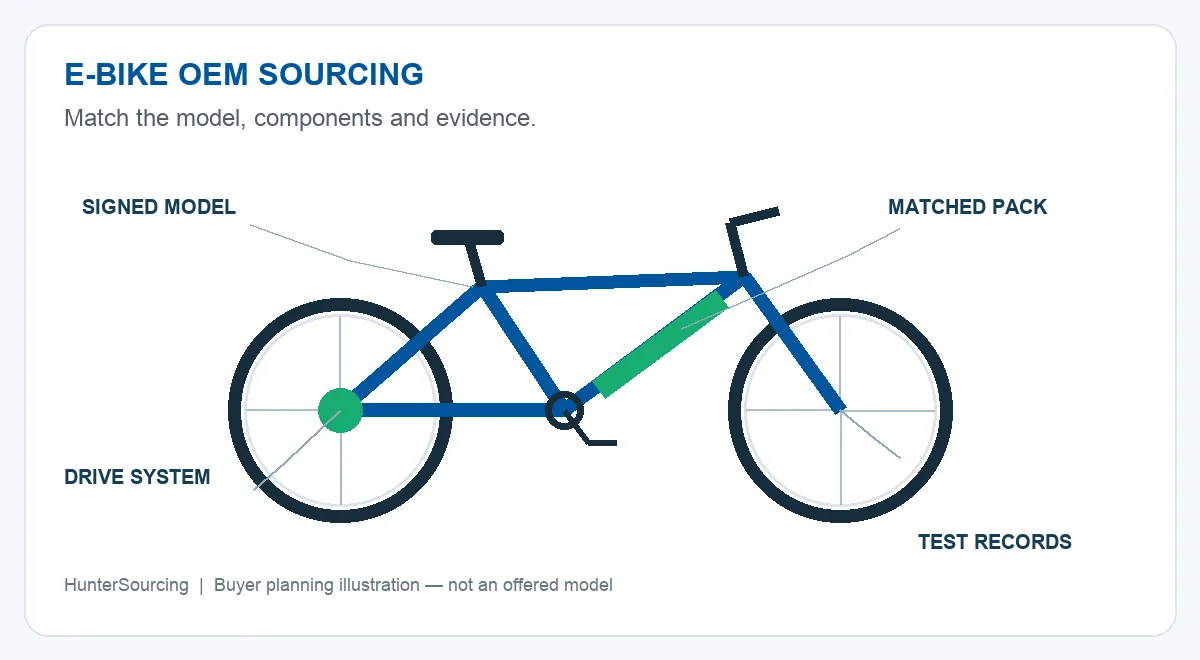
Compare commuter and folding platforms, then freeze branding and the component list.
Start with payload, route distance, charging access and service support.
Bring its offer and model sheet to discuss comparison and verification.
1. Choose the Vehicle and Market Before the Factory
Start with pedal-assisted bicycles for commuting, folding or cargo use. Electric motorcycles and dirt bikes require a different product and approval assessment; they are not the focus of this guide.
| Buying route | Specification that decides the shortlist | Evidence to request |
|---|---|---|
| Urban dealer or commuter range | Pedals, continuous rated motor power, assistance cut-off, frame sizes and local service | Destination-specific configuration, model documents and service terms |
| Cargo or delivery fleet | Approved payload, braking, duty cycle, charging access and cargo mounting | Load limits, route-test conditions, maintenance plan and replacement-pack availability |
| Folding or compact retail range | Folded dimensions, hinge locking, weight and charger/storage arrangements | Signed dimensions, folding-cycle requirements and packing/assembly instructions |
| Off-road or moped-style products | Actual power, speed, controls and intended use | Correct market category and approval route; do not assume ordinary bicycle rules apply |
For a conventional bicycle line, our China bike manufacturer guide covers a different sourcing route. For electric products, start with the whole system rather than treating a motor as the only extra component.
2. Build a Manufacturer Shortlist with Traceable Claims
Use the publications below as research starting points. Location and production statements are supplier-published; the actual contracting entity, manufacturing site and order configuration still need verification. The list summarizes the suppliers’ published product, company and production information.
| Supplier / published location | Product route and factory claim | Evidence before shortlisting |
|---|---|---|
| Ecoway Tech — Changzhou, China | Complete city, folding and cargo e-bikes; OEM/ODM and drive-system options | Legal entity/site, exact assembly and component scope, order-specific document coverage |
| TXED — Tianjin, China | Cargo/courier bikes and OEM fleet configurations; published assembly process | Selected export configuration, final-assembly responsibility, dated test and support records |
| Haidong — Wuxi, China | Supplier publishes an e-bike plant and product range | Manufacturing entity/address, chosen platform, sample records and applicable model documents |
2.1 Compare five published model examples
Compare within your use case rather than treating these different layouts as interchangeable. Figures below were read from the linked product pages on 9 November 2026; they are supplier declarations, not our measurements, stock availability or firm offers.
| Model / use | Published drive and frame | Battery energy basis | Brakes / unresolved fields |
|---|---|---|---|
| Ecoway CB1-H — city | 36 V 250 W rear hub; 6061 aluminium | 417.6 Wh in overview; 36 V × 11.6 Ah = 417.6 Wh; specification text also says 504 Wh | Mechanical disc; obtain corrected battery sheet; net weight not recorded |
| Ecoway FB1-H — folding | 36 V 250 W hub in specification table; 20-inch folding aluminium | 36 V × 10.5 Ah = 378 Wh | Mechanical disc; description also says 350 W and differs on gearing: freeze the exact version |
| Ecoway CG1-M — cargo | 36 V 250 W mid drive; 20-inch 6061 aluminium | 36 V × 10.4 Ah = 374.4 Wh; supplier rounds to 375 Wh | Hydraulic disc; confirm load definition, net weight and optional second pack |
| TXED EU Courier 27.5 — courier | 250 W rear hub; aluminium; 27.5 × 2.10-inch tyres | 36 V × 10.4 Ah = 374.4 Wh (calculated) | Hydraulic disc; obtain weight, cargo load limit and configuration-specific documents |
| TXED Heavy-Duty Cargo 20 — cargo | Steel; rear hub; 20 × 3.0-inch tyres; power options published | 48 V × 25 Ah = 1,200 Wh | Hydraulic disc; lock the power/throttle version; net weight and payload need confirmation |
What the discrepancies teach a buyer: a catalogue is an initial lead, not a signed bill of materials. Resolve inconsistent Wh, rated power or gearing before sample approval. Ask for dated battery and motor labels, model/version, measured net weight and the definition of payload. Do not infer legal classification or certification from a model name.
3. Freeze a Comparable E-Bike Specification
A signed specification protects the comparison when suppliers quote different cells, controllers, brakes or packaging. Mark each field as fixed, acceptable alternative, or subject to sample approval.
| Item | Detail to fix in the RFQ | Buyer acceptance evidence |
|---|---|---|
| Frame and fit | Material/alloy, geometry, sizes, weld/finish requirements, colour and decal artwork | Drawing or geometry sheet, approved sample and colour reference |
| Drive system | Motor model, continuous power, torque conditions, sensor type and controller version | Model plate, matched controller/display and configuration record |
| Battery pack | Nominal voltage, Ah/Wh, cell identification, pack/BMS model, connector and enclosure | Pack specification, traceable labels and applicable test/certification records |
| Charger | Exact model, output voltage/current, plug and permitted pack combination | Matched system documentation and supplier-approved charging instructions |
| Brakes and wheels | Brake model, rotor size, tyres, rims, spokes and load limits | Component references, test requirements and assembly checks |
| Dimensions and mass | Frame size, assembled/folded dimensions and declared net weight | Measurement method and approved tolerance |
| Controls and lighting | Display, firmware, speed settings, lights and control layout | Destination configuration and change-control record |
| Packing | Assembly state, protection, carton dimensions, gross mass, accessories and manuals | Packing trial, carton/label sample and agreed transport plan |
Capacity example: nominal energy is voltage × amp-hours. A 36 V × 14 Ah pack is 504 Wh; a 48 V × 14 Ah pack is 672 Wh. These are arithmetic examples, not offered products or measured riding ranges. The same Ah figure does not mean the same stored energy.
Compare range only under stated load, speed, assist level, terrain, temperature and test method. The lithium battery sourcing guide is relevant to supplier research; a generic battery product is not automatically compatible with an e-bike system.
3.1 Choose components for the duty cycle
| Choice | Buying implication | Compare in the sample |
|---|---|---|
| Rear-hub versus mid drive | Match motor location and gearing to the route and your service capability; there is no universal best system | Loaded starts and gradients, handling, component access and compatible spares |
| Cadence versus torque sensing | Cadence sensing detects pedalling movement; torque sensing measures pedalling force. Controller tuning also affects response | Start/stop behaviour, low-speed control and assistance under the intended load |
| Battery energy and serviceability | Compare Wh with pack dimensions, mass, removal/locking, permitted charger and replacement route | Exact pack/BMS identity, safe manufacturer-approved charging and how replacements are sourced |
Bafang explains sensor inputs and drive-system differences. A hub motor is not automatically limited to cadence sensing, and a mid drive does not by itself prove a particular sensor or quality level. Record the actual combination.
4. Compare MOQ, Prices and Lead Times on the Same Basis
Compare the same model, component revision, quantity and delivery term. Public commercial examples establish questions to ask; they do not establish a universal e-bike price or a HunterSourcing quotation.
4.1 Separate branding, configuration changes and new development
| Order route | Scope to agree | MOQ, sample and timing questions |
|---|---|---|
| Existing platform / branding | Approved platform, colour/logo, label/manual and packing changes | Minimum by model/colour; sample availability; artwork freeze and current component stock |
| Configuration change | Motor, pack, brakes, sensor, firmware or other component changes | Compatibility and document review, revised sample, additional tests and component minimums |
| New frame or platform | Geometry, tooling, design responsibility, ownership and validation | Development milestones, tooling/sample fees, test programme and production MOQ; quote separately |
4.2 Published minimums and milestone conditions
| Supplier source | Public commercial example | Starting condition to put in the offer |
|---|---|---|
| Ecoway | 30–50 units/model; sample orders 1–5 | Confirm whether the selected ODM platform and customization match that minimum |
| TXED cargo/delivery | 30 units/model/colour; samples 3–4 weeks; production about 60 days | Supplier starts sample preparation after full sample payment; confirm specification freeze, MOQ and production start separately |
| Bike-Manufacturer.com | 50 units/model; published production lead time 40–55 days | Supplier says components/customization affect timing; starting event requires a written agreement |
Production, inspection/correction, dispatch, transit, clearance and final delivery are separate dates. Add component shortages and peak-season contingencies to the order schedule rather than promising that a quoted production time is a delivered date.
4.3 Return every quotation in the same fields
| Offer field | Supplier A / B / C must each state | Decision supported |
|---|---|---|
| Exact product | Model, component-list revision, colour/size mix and quantity | Are the offers for the same bikes? |
| Unit and tier price | Currency/unit, requested quantity breaks, quote date and validity | Does a discount change the specification or order condition? |
| Delivery basis | Incoterms® version, named place/port and included transport | Which transport and handling costs remain outside the offer? |
| One-off and recurring extras | Sample, tooling, testing, inspection, packing, spares and recurring fees | What is included, excluded or still unquoted? |
| Payment and acceptance | Deposit/balance conditions, sample approval and release evidence | What must be completed before the next payment? |
Obtain dated quotations for the chosen configuration instead of building a budget from an unrelated low asking price.
Landed cost per saleable bike = attributable order costs ÷ accepted saleable quantity. Add only costs excluded from the quoted term: freight/insurance, dangerous-goods handling where applicable, broker-confirmed duties/taxes, terminal and delivery charges, and agreed inspection or spares. Compare ownership costs separately, including maintenance and downtime assumptions.
5. Check Market and Battery Evidence Before Payment
Bicycle classification, electrical safety certification and battery transport documents serve different purposes. Match the evidence to the product and destination rather than accepting a page of unrelated logos.
| Evidence or market | What the source establishes | What you should obtain |
|---|---|---|
| United States: CPSC bicycle guidance | Its low-speed bicycle definition includes operable pedals, motor power below 750 W and motor-only speed below 20 mph under the stated 170 lb rider test | Exact configuration and applicable product-safety evidence; check state/local operating and sales rules separately |
| Great Britain: EAPC rules | Continuous rated power no more than 250 W; assistance cut-off at 15.5 mph; riders must be 14 or older | Correct power/cut-off markings and documentation; establish any approval needed for throttle or non-EAPC variants |
| Electrical system: UL certification verification | Certification of a battery, motor or charger is not the same as certification of the complete micromobility device | Exact certification listing/model, system configuration and permitted battery/charger combination |
| China-origin EU imports: Commission trade measures | Anti-dumping and countervailing measures were extended in 2025 | Current producer-specific rate and origin evidence checked by the broker before committing to a landed-cost figure |
| Battery transport: IATA 2026 guidance | Transport rules distinguish batteries and battery-powered vehicles and reference UN 38.3 testing | Current carrier classification, pack test summary, packing/labels and any required declaration |
A claim such as “tested to UL 2849” is not by itself proof of certification. UL explains the difference between testing and certification. Check the issuer, model, factory and configuration against the listing. EN 15194 documentation, CE-related obligations and electrical-system listings must also be matched to the applicable market and final design.
For air cargo, the 2026 IATA vehicle guidance includes state-of-charge restrictions for battery-powered vehicles above 100 Wh. Have the trained shipper and carrier establish the applicable route; do not reuse old battery shipping labels or classify a whole vehicle as ordinary equipment without review.
5.1 Match the model to the issuer and the battery
| Evidence | Fields to compare | If they do not match |
|---|---|---|
| Product/system certification | Actual issuer, holder, covered model, standard, file number and status; compare exact bike/pack/charger labels | Ask the issuer to confirm scope and any model-family mapping; do not accept a different model or the words “tested to” alone |
| Applicable declaration / US certificate | Exact model, responsible entity, applicable requirements, dated signature and supporting test-record references | Request the applicable signed declaration or certificate and an evidence index; a generic CE image is insufficient |
| UN 38.3 test summary | Pack or documented product mapping, manufacturer, laboratory, report/date, Wh, mass and results | Resolve identity/energy differences with the supplier or laboratory before booking freight |
| Sample-to-production identity | Pack/BMS, charger output/model, controller/display and configuration revision | Require written approval and evidence review before substitution |
Use the actual issuer’s directory: UL Product iQ, Intertek directories or TÜV Rheinland Certipedia. Certification to a UL standard by another issuer need not appear in UL’s own database. An absent search result calls for issuer follow-up; it is not conclusive proof of fraud.
Keep one document map: signed configuration → sample labels → issuer/model records → pack transport summary → production checks → dispatch identity. A cell-brand claim, ISO management certificate or SDS cannot substitute for this product-level mapping. PHMSA explains the UN 38.3 test-summary fields. Air-cargo classification and state-of-charge conditions must be confirmed for the actual complete-bike, removed-pack or spare-battery arrangement by the trained shipper and carrier; do not transfer air rules to sea freight.
6. Verify the Factory and Control Quality Failures
A useful inspection connects the approved sample to identifiable production units. Agree the inspection lot, sampling plan, defect categories, specialist tests and acceptance requirements before production; visual sampling does not establish every bike is defect-free.
- Identify: manufacturing entity/site → contracting seller/exporter → payment beneficiary. Record documented relationships where names differ.
- Approve: sample ID → signed component revision → labels, firmware/modes, colour and packing.
- Check: agreed production sample/units → recorded findings → evidence tied to the lot.
- Correct: defect record → supplier corrective action → agreed reinspection.
- Close: buyer acceptance/rejection → identified shipment or documented hold.
| Check | Record to retain | Acceptance basis |
|---|---|---|
| Identity and components | Model/serial or batch labels; pack, charger, motor/controller and brake references | Approved component list and documented permitted alternatives |
| Assembly and function | Check sheet, observations, agreed torque records and competent functional-test results | Manufacturer method plus the buyer-agreed inspection scope |
| Braking, load and durability | Applicable specialist reports and the configuration tested | Selected market/product requirements and commissioned test method |
| Packing and accessories | Carton dimensions/gross mass, manuals/labels, assembly state and accessory count | Approved packing sample, protection requirements and packing list |
| Release and dispatch | Defect disposition, reinspection evidence and matching unit/lot/loading records | Written buyer release for accepted goods; unresolved critical findings held |
6.1 Examples of how a finding is resolved
- Unapproved pack substitution: identify affected units and compare pack/BMS/charger and document scope. Hold release where warranted; obtain correction or a buyer-approved documented disposition and agreed reinspection.
- Different brake model: compare the ordered reference and test implications. Do not accept “equivalent” without the buyer’s written approval and necessary evidence.
- Packaging damage: record affected cartons and inspect the goods. Replace packaging or correct damaged units, then retain reinspection and loading records.
These are illustrative handling procedures, not completed client cases. For limited failures, the buyer may authorize shipment of segregated accepted goods while the supplier corrects failed units, subject to safety, compliance and the contract. For widespread or critical failures, hold release and obtain a corrective-action plan and agreed second inspection. The task ends with the buyer’s documented acceptance or rejection; it is not automatic approval because most checks passed.
Discuss the actual scope through our China quality inspection service. Laboratory tests and certification are separate from routine visual/functional inspection.
Third-party video on sourcing e-bike parts, included as background for component selection and supplier questions.
7. Agree Shipping, Payment and After-Sales Responsibilities
Confirm delivery feasibility before promising a retail launch. Production completion, carrier departure, customs release and local delivery are separate milestones.
| Stage | Agreement to record | Evidence before the next payment or release |
|---|---|---|
| Before deposit | Contracting entity, fixed configuration, commercial term and change procedure | Signed quotation/contract, bank-beneficiary match and approval responsibilities |
| Sample approval | Acceptance requirements, approved pack/charger combination and document scope | Sample record, component list and unresolved-action list |
| Before balance/release | Production readiness, inspection findings and correction conditions | Buyer-approved release decision and required shipment documents |
| Shipment and destination | Battery transport route, packing, insurance and named delivery point | Carrier acceptance, packing/loading evidence and broker requirements |
| Warranty support | Territory, time/usage limits, parts/labour/freight coverage and claim process | Written responsibilities, compatible-parts list and contact/escalation route |
Ask for replacement pack, controller, display and charger availability, compatibility and lead-time terms. A similar-looking connector or a shared voltage does not establish compatibility. Do not rely on unsafe substitutions or user modifications to solve a supply gap.
Deposit and balance percentages are negotiated commercial terms, not a universal sourcing rule. Use the agreed milestones and payment-protection route; establish responsibility for a failed inspection, replacement freight or a recall before the order. Discuss a route-specific logistics plan with the carrier and broker.
7.1 Agree a usable warranty and spare-parts route
- Before ordering: list covered components, start event, territory, exclusions, response/escalation route and compatible spare-part references tied to model/batch.
- When a fault is reported: record serial/batch, symptoms, photographs, usage and the manufacturer’s requested evidence. Unsafe battery work belongs with competent specialists.
- Before a replacement: confirm controller/display/firmware, connector and system compatibility; record stock, quoted dispatch time, and who pays parts, labour, freight and import charges.
- At closure: retain the supplier’s decision, agreed corrective action, replacement identification and buyer confirmation. A warranty headline is not a promise that parts are in stock.
8. Use the Evidence for Your Buying Scenario
8.1 First private-label commuter order
Start with a limited model range and a destination-suitable platform. Freeze the battery/charger system, fit and safety documents before artwork and packaging. Your useful decision pack is the signed specification, sample approval, dated comparable quotation and inspection/release plan.
8.2 Delivery fleet or rental operator
Define daily distance, payload, charging windows, storage and service access. Ask for a documented test route and the load/temperature/assist conditions behind any range statement. Assess replacement battery availability and maintenance turnaround alongside acquisition price.
8.3 Dealer expanding an existing range
Compare the offered configuration with the parts and service capabilities already available to your customers. Establish whether firmware, diagnostics, battery interfaces or warranty claims require a proprietary route. Agree a spare-parts order and support responsibilities before extending the catalogue.
These are purchasing scenarios, not claimed HunterSourcing customer projects. Real project records, where available and cleared for sharing, should show the requirement, dated checks, finding, corrective action and acceptance outcome.
9. Electric Bike Manufacturer FAQ
These questions address supplier identity, sample-to-bulk consistency, evidence, compatibility and support. Answers combine procurement guidance with the linked official and supplier sources; individual buyer discussions identify concerns, not verified industry-wide outcomes.
9.1 How do I verify the factory, exporter and company receiving payment?
Ask for the manufacturing entity/site, contracting seller, exporter and payment-beneficiary names. Record the documented relationship if they differ and verify it through an independently established company contact before paying. Product photos and marketplace badges do not establish who manufactures the bike or who owes the contractual obligations.
9.2 What should I send to get a useful OEM quotation?
Send your destination, product category, quantity, frame sizes, motor/control requirements, battery and charger specification, brakes, branding and packing needs. Ask every supplier to quote the same delivery term and list exclusions, validity, MOQ and milestone dates.
9.3 Can I order a sample before meeting the production MOQ?
Ask separately for sample, existing-platform private-label and new-development order routes. Supplier publications differ; Ecoway, for example, lists sample orders of 1–5 units alongside larger ODM minimums. Confirm cost, specification and sample transport in writing.
9.4 Is a UL-certified battery enough to call the whole e-bike certified?
No. Battery or component certification is not the same as certification of the complete micromobility electrical system. Verify the exact product/model and permitted component combination with the certification issuer or listing database.
9.5 How do I check an advertised riding range?
Request the test load, terrain, speed, assist level, temperature and usable battery conditions. Compare energy in Wh, not Ah alone, and require the supplier to explain the test method. A marketing maximum is not a guaranteed fleet route result.
9.6 Can I use a different battery or charger if the original becomes unavailable?
Only use a combination approved for the system and supported by the necessary documentation. Confirm mechanical fit, electrical ratings, connector/protocol, BMS/controller compatibility and certification scope. Do not assume a matching voltage makes a substitute safe or compliant.
9.7 Can a high-power model be imported and sold as an ordinary e-bike everywhere?
No. The destination’s product classification, approval route and use restrictions matter. A model intended for off-road, moped or motorcycle use may fall outside pedal-cycle rules. Establish the classification before ordering rather than relying on the seller’s product name.
9.8 How should I ship complete bikes and spare lithium batteries?
Have the trained shipper and carrier classify the complete vehicles and any separate batteries under current rules. Obtain the required test summary, packing/marking and shipment documents. Air, sea and carrier conditions differ; do not copy an old classification from an unrelated product.
9.9 Does approving an OEM sample lock the components in my bulk order?
Only an agreed specification and change-control process make the approved components explicit. Retain the sample ID and signed component revision for motor, pack/BMS, charger, controller/display, brakes and other agreed parts. Require written buyer approval before substitutions and compare production units against that record; sample approval alone does not verify the bulk lot.
9.10 What should warranty and spare-parts terms cover before I pay?
Record coverage territory, time/usage limits, excluded conditions, required evidence, claim response route and responsibility for parts, labour, freight and taxes. Agree compatible replacement parts and availability terms; do not treat a short warranty headline as the full contract.
Buyer questions include sample purchases and supplier confidence, correct replacement controllers and similar bikes offered by different sellers. These self-reported discussions highlight buyer questions and experiences for further investigation.
10. Discuss Your E-Bike Sourcing Project
Send your destination, intended use, quantity and any model sheet or supplier quotation you already have. We first clarify what you need and which sourcing tasks are appropriate; a factory search is not required if you already have a candidate supplier.
10.1 Agree the service and the decision records
- Supplier research and comparison: an agreed shortlist and recorded differences in identity, model scope, configuration and commercial terms.
- Sample coordination: a sample brief, component/label record, open-issue list and buyer approval record for the agreed scope.
- Order follow-up: milestone and substitution records against the approved specification.
- Inspection coordination: findings, supporting evidence, limitations and corrective-action/reinspection status within the commissioned scope.
- Shipment coordination: the agreed packing, document and dispatch checks with the supplier and logistics parties.
These describe records to agree for a project, not claims that every package includes every activity. Supplier audits, samples, laboratory work, certification, inspection, reinspection and freight may have separate fees. We confirm responsibilities and charges before chargeable work.
10.2 Use the sample to answer the outstanding questions
Before buying the sample, agree its model and component revision, the intended market, the checks to perform, who approves it, sample/transport charges and what happens after a failed check. Retain photographs of labels, component references, firmware/modes and packing. For cargo use, agree a competent loaded-route evaluation under manufacturer-approved conditions; range and payload marketing claims are not your acceptance plan.
Download the blank e-bike RFQ and supplier-comparison worksheet (CSV). Use it to collect comparable responses; it is a planning template, not a supplier quotation or completed inspection.
10.3 Tell Us About Your E-Bike Project
Email, destination, intended use and quantity are enough to begin. Phone and budget are optional.
The website uses a 24-hour reply target. Your details are used to respond to this inquiry; see our privacy policy. You can also email info@huntersourcing.com.
Prepared by Lancy Won for HunterSourcing. This procurement guide combines supplier-published specifications, official references and practical buying considerations. Supplier and official publications reviewed 9 November 2026; confirm current documents and commercial terms for the order.
Related Articles
Related Post

Furniture is a must for an office or a home. It is available at varying price points as Read more

Wood is extensively used in making furniture around the world. Wood can be molded in any shape or Read more

China offers many types of sofas at an affordable price. When it comes to Chinese Sofa Manufacturer, This Read more
Get Free Quote

Contact Us Get Free Quote!
* Please kindly fill out the form for inquiry
* we will reply to your inquiry within 24hours